
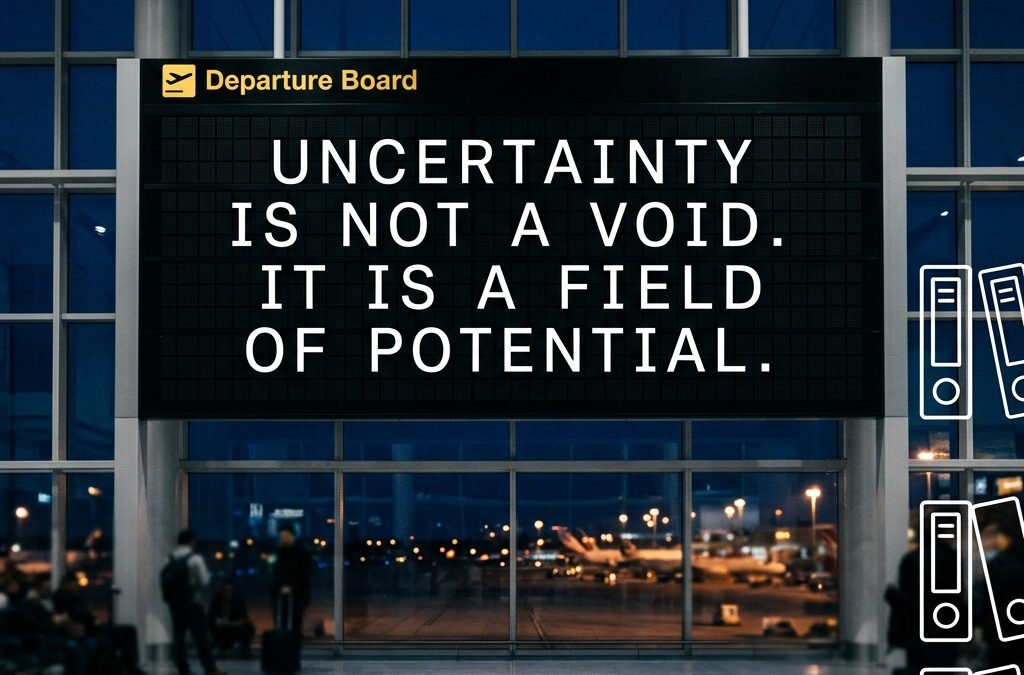
I have been thinking about uncertainty differently lately, and I want to share what has emerged from that inquiry. Most of us treat uncertainty as something to eliminate or minimize, as if the goal of good planning is to remove all question marks from the equation. But what if uncertainty is not a gap in our knowledge but rather a space we can navigate with intention and curiosity?
This is where Spaciology becomes useful. In my work exploring space as metaphor, I have come to understand that uncertainty creates a particular kind of terrain, one that is neither empty nor chaotic but rich with possibility. When we do not know what comes next, we stand in a space where multiple futures coexist, where the path forward has not yet been determined by our assumptions or our need for control.
The companies that thrive in this space are not the ones with the most detailed plans. Research shows that organizations that align their risk strategies with future opportunities position themselves as market leaders, capable of leveraging uncertainty to fuel innovation and drive growth. They are not paralyzed by what they do not know but energized by what might become possible because of it.
I have noticed something in my own life and in the work I do with others. The moments when I feel most stuck are not the moments when I face genuine uncertainty but the moments when I pretend I have certainty and then try to force reality to match my plan. The discomfort comes not from the unknown but from the friction between what I think should happen and what actually unfolds.
What Uncertainty Actually Offers
When you stop treating uncertainty as a problem to solve, you start to see it as a condition to work within. This is not about being reckless or abandoning structure. It is about recognizing that handling uncertainty well is a major competitive advantage because so few people and organizations are able to do it.
The shift happens when you move from asking “How do I eliminate this uncertainty?” to asking “What does this uncertainty make possible?” That second question opens up a different kind of thinking, one that is less about control and more about adaptability, responsiveness, and learning as you move forward.
In Spaciology terms, uncertainty is the space between where you are and where you might go. It is not a void. It is a field of potential that becomes navigable when you stop demanding a map before you take the first step.
The Practice of Moving Without Certainty
I do not have a formula for this, and I would be suspicious of anyone who claims to. But I have found a few things that help when I am standing in uncertain space and trying to decide what to do next.
- Pay attention to what feels like movement versus what feels like waiting. Sometimes waiting is the right choice, but often what we call “waiting for clarity” is actually avoidance dressed up as prudence. Movement does not require certainty. It requires a willingness to take a step and observe what happens.
- Hold your plans lightly. Make them, but do not attach to them as if they are the only possible way forward. Plans are useful as starting points, not as contracts with the future. When conditions change, change with them rather than defending a plan that no longer fits the terrain.
- Ask yourself what you are learning as you move forward. Uncertainty becomes less threatening when you frame each action as an experiment rather than a commitment. You are not locking yourself into a path — you are gathering information about what works and what does not.
What This Means for You
If you are facing uncertainty right now, whether in your work or in your life more broadly, I want to offer this: you do not need to have it all figured out before you move. The clarity you are waiting for might not come from more planning or more analysis. It might come from taking a step and noticing what that step reveals.
Uncertainty is not a sign that you are doing something wrong. It is a sign that you are doing something that matters, something that has not been done before in exactly this way. The space in which you are standing right now is not empty. It is full of possibility, and you get to explore it.
Spaciology Learning Commons
Want to go further? Join the Spaciology Learning Commons.
Membership is free and gives you access to community conversations, courses, introductory resources, and the complete Spaciology Field Guide.
RPL
Your story is your strategy.
RPL helps individuals, organizations, and teams turn narrative into infrastructure—aligning purpose, leadership, fundraising, culture, and communication around one coherent story.
Whether you are a person navigating a life transition, a leader seeking clarity, or an organization preparing for what is next, we help you move from scattered to strategic.
About Spaciology
Spaciology is not abstract theory; rather, it is a practice you can feel.
- Inside: Pause, breathe, notice.
- Outside: Design rooms, rituals, and agendas that slow the spin and invite care.
- Between us: Make dialogue a place where different truths can live together long enough to teach something.
Ultimately, leadership is the art of making space for what’s important (for everyone) and letting that clarity shape the next step. When we change the spaces from which we lead, our strategies change with them.
Stay in Touch
