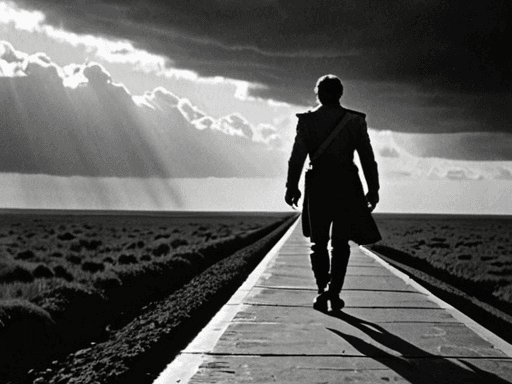
Beyond the Hero’s Journey (Part I)

Beyond the Hero’s Journey (Part I)

Watch

Read

Floods, wildfires, drought, biodiversity loss, habitat destruction, pollution, mass riots, war—this is the world right now in active ecological crisis. There is very little recognition, though—much less discussion—about the interrelatedness of these issues, which underscores the urgent need for a transformation in our collective worldview that allows for sanctity of diverse perspectives across cultures.

Deconstructing the Hero’s Journey: The Western Worldview’s Role in Our Crisis

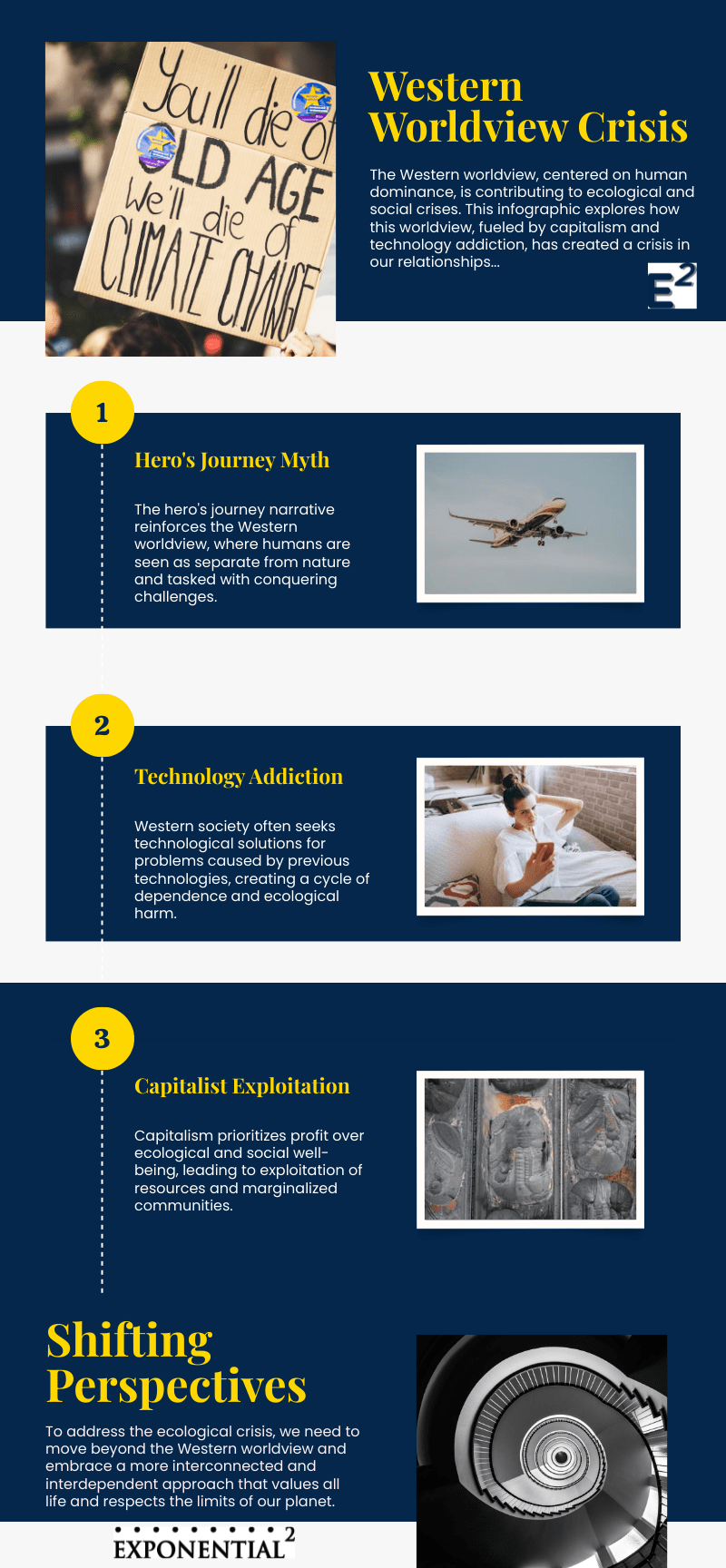
However, a prevailing model for personal and societal transformations is the hero’s journey that, although pervasive, offers a version of reality that feeds the Western worldview within which humans are centered (and in command). The current crises we face as a species demand that Westerners, especially Anglo-American, cisgendered White males (like me), consider their worldview as a primary cause. This worldview is characterized by what Robinson-Morris (2019) said is “the West’s misguided understanding of self, our interconnectedness and interdependence” (p. 3).

Western society, however, does not appear ready to collectively question its worldview. Instead, Westerners individually look outward. Nature and various social issues are objectified as characters in a story. Climate change is characterized as the foe (or monster) within this story, which humans (as heroes) can defeat with the tools (also heroes) of science, technology, or legislation. Simultaneously, these same tools are wielded in an (often separate) attempt to address the complex array of social issues faced by governments and other institutions worldwide.
Beyond the Hero's Journey

Questioning Western Tools

What if European American (Western) culture’s very use of its tools—science, technology, and/or legislation—is creating the issues that must be solved? The Western (European American) belief in technology reflects a kind of addiction where many people embrace technological fixes as “the answer to social, psychological, and medical problems caused by previous technological fixes” (Glendinning, 1995, p. 49).

Capitalism’s Role: Profit, Exploitation, and the Ecological Crisis

This addiction is part of a larger Western worldview that has not just contributed to the ecological crisis but caused it (X. Chen, 2017). Fueled by capitalism, the Western worldview has led to the exploitation of nature and (marginalized) people as objects whose value is only measured in their utility (Marx, 2005). As a species, we must not only acknowledge the Western world’s addiction to technology but also what X. Chen (2017) referred to as a thirst for profit and capitalist modes of production. The ecological crisis, then, results from the inability of the hero to satiate this thirst.

Embracing New Metaphors: Moving Beyond the Hero’s Journey

In part two of this expansive file, I will explore this proverbial thirst as well as the ubiquity of the hero’s journey, which underscores the need (opportunity) to embrace new metaphors.

References
Chen, K.-H. (2010). Asia as method: Toward deimperialization . Duke University Press.

Glendinning, C. (1995). Technology, trauma, and the wild. In T. Roszak, M. E. Gomes, & A. D. Kanner (Eds.), Ecopsychology: Restoring the earth, healing the mind (pp. 41–54). Counterpoint.

Marx, K. (2005). Grundrisse: Foundations of the critique of political economy (M. Nicolaus, Trans). Penguin.

Robinson-Morris, D. W. (2019). Ubuntu and Buddhism in higher education: An ontological (re)thinking. Routledge.

About Spaciology

Spaciology is not abstract theory; rather, it is a practice you can feel.

  • Inside: Pause, breathe, notice.
  • Outside: Design rooms, rituals, and agendas that slow the spin and invite care.
  • Between us: Make dialogue a place where different truths can live together long enough to teach something.

Ultimately, leadership is the art of making space for what’s important (for everyone) and letting that clarity shape the next step. When we change the spaces from which we lead, our strategies change with them.

Spaciology Learning Commons

Want to go further? Join the Spaciology Learning Commons.

  • Free membership gives you access to community conversations and introductory resources.
  • Paid membership opens full access to courses, live sessions, and the complete Field Guide.

Stay in Touch

Space as Metaphor: Beyond Output-Oriented Paradigms (Part II)

Space as Metaphor: Beyond Output-Oriented Paradigms (Part II)

Watch

Read

Strategic plans are particularly excellent examples of a process with questionable results, especially if stakeholder collaboration is desired (Tiwari & Winters, 2017). The logic behind strategic plans, however, is indicative of the Western paradigm’s contradictory view of the individual as of primary significance, yet also replaceable.

The Western worldview rests on the Cartesian assumption that the mind is more important than the body. Though subtle, this assumption supports the ability of many Westerners to engage in disjunctive thinking (Morin, 2014) in order to break down complex problems into proverbial bottom lines that can be mapped through pure reason alone.

Strategic plans are particularly excellent examples of a process with questionable results, especially if stakeholder collaboration is desired (Tiwari & Winters, 2017). The logic behind strategic plans, however, is indicative of the Western paradigm’s contradictory view of the individual as of primary significance, yet also replaceable. The Western worldview rests on the Cartesian assumption that the mind is more important than the body. Though subtle, this assumption supports the ability of many Westerners to engage in disjunctive thinking (Morin, 2014) in order to break down complex problems into proverbial bottom lines that can be mapped through pure reason alone.

There is indeed vital information in our bodies, however, and even in the silence in our physical movements:

The silence is not merely golden; it is replete with meanings. Those meanings in turn testify to a corporeal semiotics, a movement-anchored corporeal semiotics that resounds within us. It resounds within the volume of our being an animate form of life, in all the so-called “systems” that functionally describe us—our respiratory, circulatory, and digestive systems, for example—some of which we can and do at times directly experience. (Sheets-Johnstone, 2019, p. 37)

There can be no substitute for what we experience in our bodies—and without our bodies, there is no mind. However, our minds also create our bodies, which are cultural representations of how we view our very selves. Indeed, the implication from this study is not that the hero’s journey has no use at all. Nearly 5,000 years of history demonstrate its ubiquity, but its relevance as a mode of transformation is misplaced in a world in desperate need for humans to remember they are part of a collective whole.

Perhaps our ability to share (external and internal) space is predicated on the extent to which we are able to be free of ourselves in order to become ourselves. Imagined without time, space as metaphor enables us to participate in creating, making, cleaning, growing, shrinking, shifting, expanding, and reconfiguring the metaphorical and literal spaces within, outside, and between us.

Whereas many of our discussions as a species revolve around borders and boundaries, space as metaphor removes the implied directionality of such conceptualizations, which inadvertently exacerbate the perceived divide that separates humans from self, one another, Earth, and cosmos. Space as metaphor is empty, yet full of potential, enabling individuals with diverse viewpoints to participate—and be heard—in collective space, a place in which there is still room for the occasional hero.

References
Morin, E. (2014). Complex thinking for a complex world—About reductionism, disjunction and systemism. Systema: Connecting Matter, Life, Culture and Technology, 2(1), 14–22.

Sheets-Johnstone, M. (2019). The silence of movement: A beginning empirical-phenomenological exposition of the powers of a corporeal semiotics. The American Journal of Semiotics, 35(1/2), 33–54. https://doi.org/10.5840/ajs20196550

Tiwari, R., & Winters, J. (2017). The death of strategic plan: Questioning the role of strategic plan in self-initiated projects relying on stakeholder collaboration. International Planning Studies, 22(2), 161–171. https://doi.org/10.1080/13563475.2016.1220288

About Spaciology

Spaciology is not abstract theory; rather, it is a practice you can feel.

  • Inside: Pause, breathe, notice.
  • Outside: Design rooms, rituals, and agendas that slow the spin and invite care.
  • Between us: Make dialogue a place where different truths can live together long enough to teach something.

Ultimately, leadership is the art of making space for what’s important (for everyone) and letting that clarity shape the next step. When we change the spaces from which we lead, our strategies change with them.

Spaciology Learning Commons

Want to go further? Join the Spaciology Learning Commons.

  • Free membership gives you access to community conversations and introductory resources.
  • Paid membership opens full access to courses, live sessions, and the complete Field Guide.

Stay in Touch

Space as Metaphor: Beyond Output-Oriented Paradigms (Part I)

Space as Metaphor: Beyond Output-Oriented Paradigms (Part I)

Watch

Read

In various fields (counseling, education, business, and leadership, etc.), transformation and change are often framed as part of a metaphorical hero’s journey. Patients, students, and employees are handed a list of goals and outcomes, and then a proverbial journey is mapped out regarding how to get there. This sort of logic generally informs not only business and productivity but also approaches to (and belief in what constitutes) knowledge in general.

In the Western world, there is an emphasis on considerations related to knowledge production and acquisition to the detriment of those related to ontology (Dei, 2000). Defined simply, ontology relates to the nature of reality, existence, and/or truth. This bias is a seminal cog in the Western wheel of life (and business) without which it would no longer easily spin. From an Indigenous perspective, ontological considerations are crucial and reflect a worldview in which everything is necessarily related to everything else.

The ways in which we ontologically express our humanity, then, are paramount, as they connect us with not just our culture and world today but also our ancestors, history, and the cosmos. For Indigenous cultures, embodiment is a way of knowing (Dall’Alba & Barnacle, 2007)—and to some extent, systems theory and the complexity paradigm validate this position, although it is not explicit.

The Western approach, however, often privileges the artifacts of knowledge as opposed to the ways in which we express and share our humanity. In European American contexts, this emphasis on knowledge acquisition and production lends itself to an output-oriented framework. 

What if the process, or the ways, in which we come to know and express ourselves, was the goal or outcome? What if treatment, learning, and strategic plans were no longer exclusively oriented around the needs and desires of the individual or organization?

In part II, these rhetorical questions are explored.

References

Dall’Alba, G., & Barnacle, R. (2007). An ontological turn for higher education. Studies in Higher Education, 32(6), 679–691. https://doi.org/10.1080/03075070701685130

Dei, G. J. S. (2000). Rethinking the role of Indigenous knowledges in the academy. International Journal of Inclusive Education, 4(2), 111–132. https://doi.org/10.1080/136031100284849

About Spaciology

Spaciology is not abstract theory; rather, it is a practice you can feel.

  • Inside: Pause, breathe, notice.
  • Outside: Design rooms, rituals, and agendas that slow the spin and invite care.
  • Between us: Make dialogue a place where different truths can live together long enough to teach something.

Ultimately, leadership is the art of making space for what’s important (for everyone) and letting that clarity shape the next step. When we change the spaces from which we lead, our strategies change with them.

Spaciology Learning Commons

Want to go further? Join the Spaciology Learning Commons.

  • Free membership gives you access to community conversations and introductory resources.
  • Paid membership opens full access to courses, live sessions, and the complete Field Guide.

Stay in Touch