
When Darius Wallace steps onto the stage to perform “Being Frederick Douglass,” something more unsettling is happening than a simple recitation of historical speeches—he is holding up a mirror to the invisible chains we still carry, the ones we have mistaken for our own thoughts, the ones we have been living inside without recognizing them as architecture at all.
Wallace has performed this show for over 23 years, and his most popular production debuted Off-Broadway in 2015 to an Audelco Award nomination. Keith Morris, the great-great-great-grandson of Frederick Douglass, praised Wallace’s performance for capturing “the nuance of my Great-Great-Great Grandfather’s humanity.” Wallace himself describes the work differently—he relates his performance to personal struggles with anxiety and depression, exploring “the question of what freedom is” through the lens of Douglass’s life, treating it not as a settled matter but as something still unfolding.
The question is not academic, I do not think—it lives in that gap between recognizing a limitation and taking action, in the space where most of us seem to get stuck.
The Architecture We Inhabit Without Noticing
I think people get stuck in existing narratives in their heads and struggle to see space around their own reactions and belief systems. This is not necessarily a failure of willpower—it may be something more fundamental, something about the way we are taught to see the world in the first place.
We live in a culture where the majority of life’s experiences are reduced to various bottom lines, and when we live by bottom lines, it becomes difficult for any of us to see space for new narratives, new ways of doing, being, or thinking. This happens in strategic planning all the time—we identify three to five outcomes an organization should achieve within a specific timeframe, then reverse-engineer what we think it will take to achieve them, as if certainty were something we could manufacture through careful planning.
That approach may not necessarily reflect how life is really experienced. None of us really knows the outcomes of anything—we live and learn by experience, by moving through spaces that reveal themselves as we inhabit them.
Krishnamurti talked about how many of us are secondhand human beings—we do not really know what we think because we are using ideas we have lifted off the shelf from somewhere, anywhere, but inside our own bodies or experience. I find myself returning to this observation because it describes something I recognize in my own thinking, the way borrowed frameworks can feel like native understanding until you pause long enough to notice the difference.
What Douglass Actually Said About Being Self-Made
Here is where the story becomes more interesting, where the complexity starts to reveal itself. Frederick Douglass is famous for his “Self-Made Men” speech, yet he paradoxically rejected the very concept he popularized—not through contradiction, but through a more nuanced understanding of how freedom actually works.
In that speech, Douglass stated that “properly speaking, there are in the world no such men as self-made men” and believed “no generation of men can be independent of the preceding generation.” This was not a contradiction—it was a sophisticated understanding that self-determination occurs within, not apart from, community and historical foundations, that we are always building on ground someone else prepared.
Douglass emphasized that “opportunity is important but exertion is indispensable,” arguing that success comes through “industry and application, together with a regard to favourable circumstances and opportunities.” He understood work as essential but never isolated from the social context that makes opportunity possible—a framework that seems worth examining more closely, given how often we flatten it into something simpler.
We live in a society where individualism is championed as part of the hero’s journey—the self-made man needs nothing other than his own strength, intellect, or way of being. Such a philosophy can lead us down some dangerous paths supported by absolute thinking, by the belief that reality is fixed and success is a solitary achievement rather than something that emerges through relationship and reciprocity.
Douglass rejected extreme individualism, emphasizing that true self-made men are formed through hard work and by capitalizing on opportunities in a shared society—a framing that changes what we might need to do differently in our own internal work of liberation.
I Am Because We Are
The best way I can answer the question of how understanding freedom as a collaborative, intergenerational project changes our internal work is to say this—I am because we are.
This is a penultimate concept in Ubuntu philosophy, translated as “I am because we are” or “I am because you are,” originating from the Bantu and Xhosa peoples of Southern Africa. The philosophy emphasizes that “a person is a person through other persons,” fundamentally rejecting the Cartesian “I think, therefore I am” in favor of communal interdependence—a different starting point that creates different possibilities for how we understand ourselves.
Kenyan scholar James Ogude explains that “Ubuntu is rooted in what I call a relational form of personhood, basically meaning that you are because of the others.” The philosophy “imposes a sense of moral obligation regarding your responsibility for others even before you think of yourself,” directly countering the “all about me” individualism prevalent in Western societies—not through moral prescription but through a fundamentally different architecture of understanding.
Everything built on that sort of idea is inherently different from the “I gotta get mine” philosophy that characterizes much of Western society today—different not in degree but in kind, creating an entirely different internal landscape.
Holding an “I am because we are” framework helps us recognize that we are not ourselves without actively considering others—I am me because of you and you are you because of me, reciprocally embedded in one another in ways that reshape what becomes possible when we examine our own limitations.
Where Freedom Actually Begins
Douglass’s philosophy suggests that if we seek freedom in physical space, it may need to begin within the spaces of our own minds and bodies—an internal construction project that precedes and enables external change.
This is not a one-time realization, at least not in my experience. For me, this process has been unfolding, and it is indeed a process—it is not a place with clear boundaries, is not static, it is happening right now. It is a practice, not a place or a time, not something you arrive at and then possess but something you inhabit differently each day.
Research on psychological freedom defines it as “the ability to be your true self, unencumbered by limiting beliefs, societal pressures, or past traumas,” involving “the mental and emotional space to explore your thoughts, feelings, and desires without judgment or fear.” The work requires developing self-awareness, emotional regulation, cognitive flexibility, and autonomy—though I find these categories more useful as invitations to exploration than as fixed destinations.
Liberation psychology, developed by Ignacio Martín-Baró in 1970s Latin America, emphasizes “de-ideologizing reality”—helping people understand how dominant ideologies obscure social forces that maintain oppression. A key insight here is that “ideology, understood as the ideas that perpetuate the interests of hegemonic groups, maintains the unjust sociopolitical environment,” which suggests that the work of freedom involves examining the frameworks we have internalized without realizing we had choices about them.
One practice I have found useful is to simply notice these limitations, to remain curious about our reactions to our own thoughts and to external stimuli. Curiosity becomes important here—not as a vague aspiration but as a specific way of paying attention to the moments when we feel stuck.
The Space Between Noticing and Acting
There is something tricky here, though—noticing a limitation and actually doing something about it are not the same thing. What happens in the space between noticing and acting that either allows movement or keeps someone frozen in place?
We can choose something different—that much seems clear.
That sounds simple, and yet if it were that straightforward, more people would be doing it. Choice often feels unavailable to many people when they try to fit their actions into an existing paradigm—if truth and reality are fixed in their heads, it becomes really hard to see, much less experience, spaces where reality itself could be messy or fuzzy, where the boundaries we thought were solid turn out to be negotiable.
Research shows that “societal expectations and norms” become internalized from a young age, “creating an inner critic that constantly judges us against an impossible standard.” Breaking free may require “courage and a willingness to question deeply ingrained beliefs” about what constitutes success and self-determination—though I think it also requires something else, something about recognizing that those beliefs are constructs we participate in rather than truths we discover.
Many of us carry invisible, psychological architecture that mirrors old systems of constraint—frameworks we inherited and then forgot we were carrying. When Darius Wallace performs “Being Frederick Douglass” today, what does a contemporary performance like that reveal about the chains we are still carrying internally, the ones we have not yet recognized as something we can examine and reshape?
Building on Foundations We Did Not Lay
The “self-made” mythology becomes dangerous when it relies on absolute thinking, when it compresses the complexity of how change actually happens into a simple story of individual willpower. Douglass himself used that language of the self-made man while also understanding something more nuanced about interdependence—something that gets lost when we flatten his philosophy into simple individualism.
What he was trying to communicate, I think, is that “capitalizing on opportunities in a shared society” means self-determination is not about isolation but about recognizing and building upon what others have created—an ongoing collaboration across time that changes how we understand our own agency.
Nelson Mandela embodied Ubuntu by asking “Are you going to do so in order to enable the community around you to be able to improve?”—a question that reframes individual enrichment as meaningful only when it enables collective flourishing, when it expands the space available to others rather than contracting it.
Ubuntu-inspired frameworks in academic settings demonstrate how “I am because we are” creates spaces where individuals “prioritize interconnectedness, dismantle hierarchical barriers, and create inclusive spaces” for collective thriving—offering a practical counter-model to competitive individualism that seems worth exploring further, not as a prescription but as a different way of organizing our thinking.
What Changes When We See Space
I think we all need space, whether it is figurative, metaphorical, or literal—and if people can see the space around their reactions and belief systems, I contend they can begin to see space for new ways of thinking, for choice itself to emerge where it seemed unavailable before.
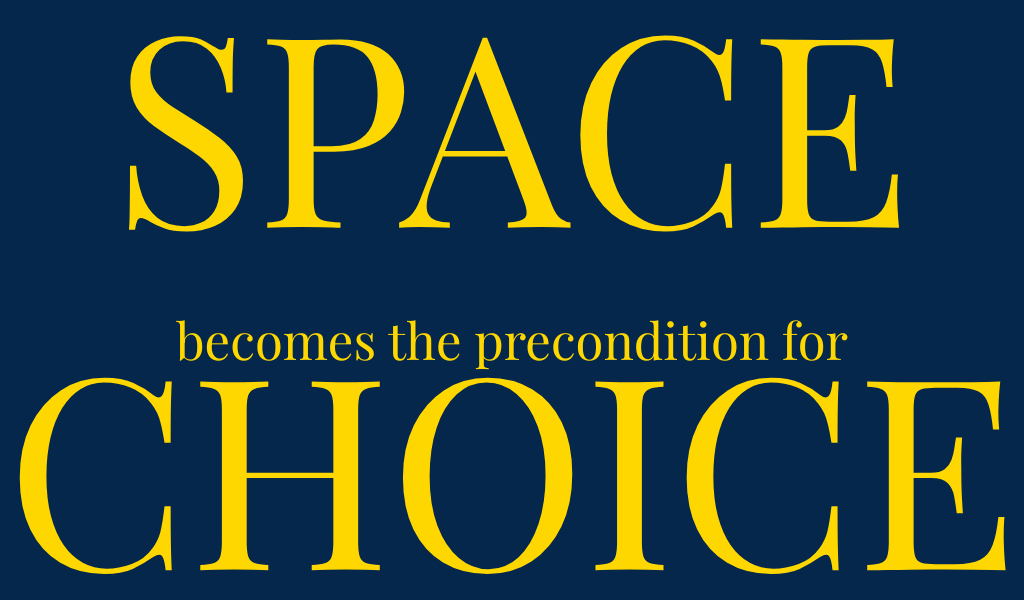
Space becomes the precondition for choice in this framework. What prevents someone from seeing that space exists in the first place, especially when they are surrounded by narratives that tell them their limitations are fixed, that reality is settled, that the way things are is the way things must be?
In the Western world especially, we are brought up in a culture where most life experiences are reduced to various bottom lines—outcomes, metrics, clear boundaries between success and failure. When we live by bottom lines, it becomes very difficult for any of us to see space for new narratives, new ways of doing, being, or thinking, because the framework itself does not leave room for the messiness of how change actually unfolds.
The work of psychological liberation involves “the critical dismantling of the dominant ideologies that perpetuate social inequalities”—it requires “a conscious effort to unmask the ideologies that legitimize and perpetuate injustice,” treating liberation not as a destination but as an ongoing practice of noticing and reshaping internalized constraints, of recognizing where we have made choices without realizing we were choosing.
Internal freedom, as philosopher Krishnamurti described it, means liberation “from inner conflicts and emotional burdens,” emphasizing that “psychological and spiritual liberation” creates “a state of mind free from division, conflict, and sorrow.” This aligns with Douglass’s understanding that freedom begins in “the spaces of our own minds and bodies”—a starting point that changes the nature of the work we might need to do.
The Practice of Seeing Differently
When you think about the gap between recognizing a limitation and actually doing something about it—that space where most people seem to get stuck—what is actually happening in there, in that particular territory between knowing and doing?
People get stuck in existing narratives in their heads and struggle to see space around their own reactions and belief systems—this is what I have observed, at least. The practice is not about arriving somewhere or achieving a particular state—it is about noticing right now, in this moment, where you have internalized a limitation and are treating it as an unchangeable truth rather than as a construct you are participating in.
Curiosity becomes the tool here—not curiosity as a vague aspiration, but curiosity as a daily practice of asking where am I operating from borrowed ideas, where am I reverse-engineering from an imagined outcome instead of working from my actual lived experience, where have I collapsed complexity into a fixed conclusion without noticing I was doing it. These questions do not necessarily have clear answers, but the asking itself creates space that was not there before.
Wallace wants audiences “to be inspired to make their lives what they want them to be”—the performance does not provide answers so much as it creates space for questions, for noticing how historical chains mirror contemporary internal constraints we still carry without recognizing them as something we could examine differently.
What Becomes Possible
Understanding freedom as an internal construction project rather than an external achievement changes something fundamental about how we approach self-determination. It means recognizing that the work begins not with changing circumstances but with examining the belief systems that shape our capacity to see what is possible—the frameworks we inhabit before we take any action at all.
It means understanding that individual progress is always built upon foundations laid by others across generations, making self-determination a collaborative rather than isolated endeavor—we are always working with materials someone else prepared, always building on ground we did not clear ourselves. It means treating liberation not as a one-time event but as an ongoing practice of noticing where we have internalized external limitations and mistaken them for unchangeable truth, where we have confused the architecture we inherited with the architecture that must be.
Douglass’s philosophy remains relevant because it addresses the space between recognizing limitation and taking action—a space where most people remain stuck, not necessarily from lack of willpower but from unexamined internal constraints, from belief systems we are operating within without recognizing we have choices about them.
The question is not whether you can be free—I do not think that framing serves us well. The question might be whether you can see the space where freedom becomes possible, the space that exists right now, in the architecture of your own thinking, waiting to be noticed and explored and perhaps reshaped into something that serves you differently than it does today.
About Spaciology
Spaciology is not abstract theory; rather, it is a practice you can feel.
- Inside: Pause, breathe, notice.
- Outside: Design rooms, rituals, and agendas that slow the spin and invite care.
- Between us: Make dialogue a place where different truths can live together long enough to teach something.
Ultimately, leadership is the art of making space for what’s important (for everyone) and letting that clarity shape the next step. When we change the spaces from which we lead, our strategies change with them.
Spaciology Learning Commons
Want to go further? Join the Spaciology Learning Commons.
- Free membership gives you access to community conversations and introductory resources.
- Paid membership opens full access to courses, live sessions, and the complete Field Guide.
Stay in Touch
