
Just a few classes into teaching business through a postsecondary prison education program, I have already learned more from my students than I could possibly teach them.
There is no room for performance in this space. The students do not have the luxury of pretending, and neither do I—and when you strip away the polished presentations, the curated expertise, the need to appear as if you have it all together, what emerges is electric. This is what I call non-performance, and it is transforming my understanding of the conditions under which genuine learning becomes possible.
What I Am Learning
In traditional classrooms, there is an unspoken contract: the teacher performs expertise, the students perform engagement, and everyone maintains the illusion that learning is a one-way transfer of knowledge. In this classroom, that contract does not hold.
In this program in particular, my students have lived experiences that far exceed anything I could teach from a textbook. They have navigated systems, survived impossible circumstances, and developed wisdom that comes from being fully present to reality—not performing their way through it. If I were to walk into that space pretending I have all the answers, they would see right through it, and more importantly, it would close off the very thing that makes learning possible.
Instead, I choose to drop the mask—to say “I do not know” when I do not know, to share the messy, half-formed ideas alongside the polished ones, to ask questions I do not have answers to and genuinely listen to what emerges in response. Something remarkable happens when I do this: the entire space shifts. When one person drops the performance, it creates permission for others to be real, too, and authenticity becomes contagious. The distance that usually exists between teacher and student—that careful separation maintained by expertise and authority—collapses, and what replaces it is connection, possibility, and the kind of learning that actually transforms people.
The Cost of Performance
I am starting to see how much energy we spend maintaining the illusion of having it together. In most professional spaces, we are rewarded for polish, confidence, and the appearance of knowing exactly what we are doing—but that performance creates a barrier to actual learning and genuine connection.
Research on performance-based work cultures shows that when people focus on meeting performance standards, they grow alienated from colleagues and frustrated by a lack of time to pursue work aligned with their actual interests—the very systems designed to measure success create barriers to authentic engagement. In the prison classroom, I watch this play out in reverse. Without the pressure to perform, my students show up with a rawness and honesty that is rare in traditional educational settings, bringing their full selves—their struggles, their questions, their lived expertise—into the space, and when I match that honesty with my own, the learning becomes reciprocal.
In this space, I am reminded that transformation does not happen in the polished lecture—it happens in the messy, honest exchange of what is true. When I show up as I actually am—uncertain, curious, still figuring it out—it creates space for everyone else to be real. This is not about being unfiltered or abandoning boundaries, but about recognizing that the performance itself is what prevents the real work from happening.
What This Requires
Non-performance requires something specific: safety. Not just physical safety, though that matters, but the kind of safety where vulnerability is possible, where dropping the mask does not make you a target, where lived experience is valued rather than extracted.
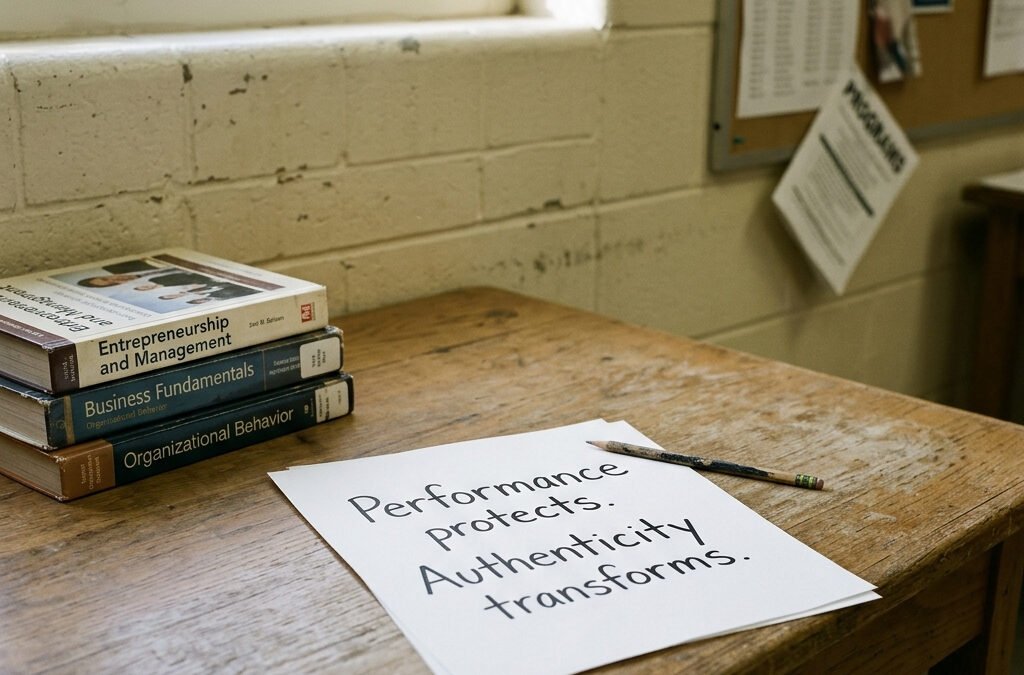
For my students, performance has often been a survival strategy. In the criminal justice system, institutional settings, and in a world that judges them before they speak, performance protects, which is why I am not asking them to be vulnerable on demand but rather trying to create conditions where they can choose to be real, where that choice is safe and their knowledge and experience are valued.
This work is delicate. For marginalized individuals, dropping ‘performance’ can be dangerous, requiring a level of safety that may not exist in most spaces. The goal is not to demand authenticity but to create space where people can show up more fully as themselves when they choose.
Research shows that, to truly learn, teachers need to feel comfortable saying “I do not know,” and the same is true for students. When leaders admit they do not know something, they foster trust and demonstrate that they value honesty over empty assurances, encouraging a culture of learning and collaboration rather than perfectionism.
In practice, this means starting our sessions differently, giving people time to actually arrive, not just appear, beginning with what is true now rather than jumping straight into content, sharing my unfinished thinking and genuinely asking what they know about topics from their own lives, and then listening.
Why This Matters Beyond the Classroom
I keep thinking about how rare this is today. In most professional spaces, posturing dominates interactions, fear of silence drives constant talking, and the most important things get said in the parking lot after the meeting rather than in the meeting itself. Over-polished presentations hide real issues, and authenticity feels risky or unwelcome.
We wait until we are “ready” and never start, curate our expertise and lose touch with genuine curiosity, perform confidence and sacrifice the learning that happens when we admit we do not have it figured out.
What I Am Still Figuring Out
This prison education program exists because someone understood that space contains both trauma and healing. My students are working toward a college degree, but the real work is what I am just beginning to understand: creating conditions where people who have been told they are disposable can discover their own agency, worth, and capacity to contribute.
Non-performance is not a technique I can package into a five-step process. Rather, it is a way of being in relationship with others that prioritizes what is real over what is polished, what is true over what is impressive.
I call this entry in my Spaciology Field Guide “Non-Performance Is the Point” because I am learning that the spaces we create are physical, relational, and emotional, and shape what becomes possible. When we drop performance, we create what I think of as home-like space, where being is privileged over appearing, shared space where one person’s authenticity gives permission for others to be real, and we collapse the distance that performance creates, opening up connection and possibility.
This idea connects to other things I am exploring, which is how listening becomes love, how care can be structured into our systems, and how boundaries actually create compassion rather than distance, which is all part of understanding that transformation requires both disruption and safety.
When we drop performance, we disrupt the status quo, but we can only do that when the space itself is safe enough to hold what is real. I am just a few classes into this teaching experience, and I already see how much I have to unlearn, how much I have to let go of my own performance to create space for genuine learning.
Non-performance is the only way this works.