
I used to believe that saying yes to everything made me a good person—a reliable friend, a supportive partner, someone who showed up when it mattered. The logic felt airtight: if I cared about someone, I would make space for their needs, even when my own internal landscape was already crowded and overwhelmed. What I did not realize at the time was that this pattern was not actually protecting the relationship—it was quietly eroding it from within, building a reservoir of resentment that neither of us could see until it overflowed.
When Yes Becomes a Lie
The problem with unclear boundaries is not that we fail to protect ourselves—it is that we fail to tell the truth about what we can actually offer. When I say yes while feeling no, I am not being generous—I am being dishonest. I am asking the other person to trust a commitment that I cannot fully honor, and I am setting up a dynamic where my eventual exhaustion or withdrawal will feel like abandonment to them. The boundary I thought I was avoiding for their sake becomes the very thing that harms them when it finally collapses under pressure.
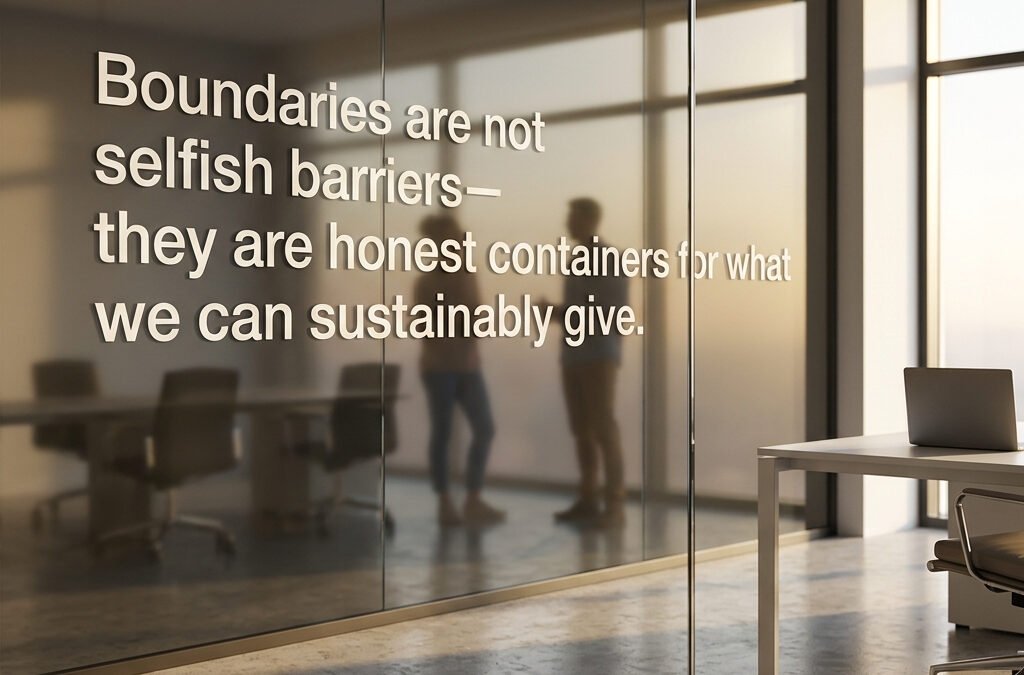
This is where the reframe matters: boundaries are not selfish barriers—they are honest containers for what we can sustainably give. When I tell you what I can and cannot do, I am not withholding care—I am offering you something reliable. I am saying, “This is the shape of my presence right now, and within that shape, I can show up fully.” That clarity creates safety, not distance.
The Harm We Think We Are Preventing
I have watched this pattern unfold in my own relationships and in the lives of people I care about—the slow accumulation of unspoken nos that eventually harden into bitterness. We tell ourselves we are being kind by stretching beyond our capacity, but what we are actually doing is teaching the other person that our presence is limitless, that their needs will always be met, regardless of cost. When that inevitably stops being true, the disappointment lands harder because the expectation was never grounded in reality with which to begin.
The people we love do not need us to be infinite—they need us to be honest. They need to know where we end and where they begin, so they can make informed choices about what to ask for and what to seek elsewhere. When we blur those lines in the name of compassion, we are not sparing them pain—we are delaying it and making it more confusing when it arrives.
What Compassionate Boundaries Look Like
Setting a boundary does not mean you stop caring—it means you care enough to be truthful about your limits. It means you trust the other person to handle that truth, and you trust the relationship to be flexible enough to accommodate it. The boundary is not a wall—it is a doorway that shows both of you where sustainable connection actually lives, where you can meet each other without one person disappearing in the process.
What this looks like in practice:
- Naming what you can offer rather than stretching to meet every request.
- Trusting the other person to handle the truth of your limits.
- Treating the boundary as a doorway, not a wall—an invitation into sustainable connection.
I am still learning this, still catching myself in the old pattern of overextending and then resenting the very people I was trying to help. I am beginning, however, to see that the kindest thing I can offer is not endless availability—it is honest presence within the space I actually have. This is where real care lives: the truthful shape of what we can give without losing ourselves.
Join the Inquiry
If this exploration resonates with you, I invite you to continue this inquiry inside The Spaciology Learning Commons—a collaborative space where we examine the internal and relational landscapes that shape how we show up in the world. This is not about finding definitive answers, but about creating space to ask better questions together.
Spaciology Learning Commons
Want to go further? Join the Spaciology Learning Commons.
Membership is free and gives you access to community conversations, courses, introductory resources, and the complete Spaciology Field Guide.
RPL
Your story is your strategy.
RPL helps individuals, organizations, and teams turn narrative into infrastructure—aligning purpose, leadership, fundraising, culture, and communication around one coherent story.
Whether you are a person navigating a life transition, a leader seeking clarity, or an organization preparing for what is next, we help you move from scattered to strategic.
About Spaciology
Spaciology is not abstract theory; rather, it is a practice you can feel.
- Inside: Pause, breathe, notice.
- Outside: Design rooms, rituals, and agendas that slow the spin and invite care.
- Between us: Make dialogue a place where different truths can live together long enough to teach something.
Ultimately, leadership is the art of making space for what’s important (for everyone) and letting that clarity shape the next step. When we change the spaces from which we lead, our strategies change with them.
Stay in Touch
