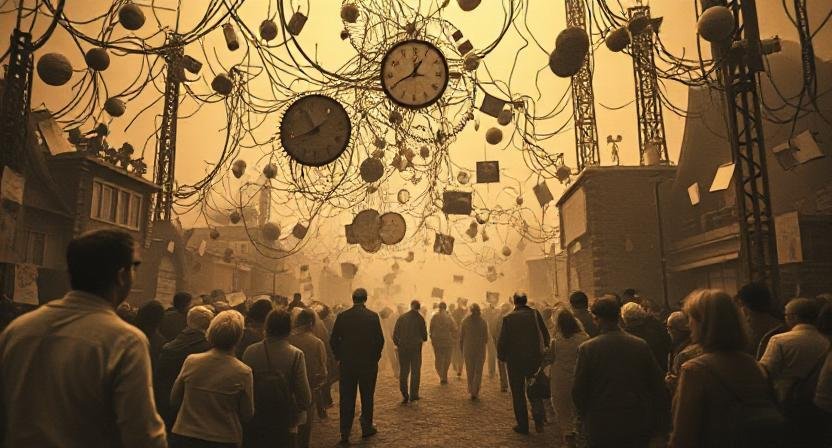
Why Slowing Down Accelerates Mission Impact

Why Slowing Down Accelerates Mission Impact

Nonprofit leaders face constant pressure to respond, react, and deliver results immediately. Email alerts about urgent donor requests blend with crisis communications and campaign deadlines. This perpetual motion feels productive, but it often prevents organizations from achieving their deepest mission impact.

The most transformative mission work emerges from creating intentional space for reflection rather than rushing from one urgent task to the next.


The Rush Trap

Mission-driven organizations operate in a unique space where human need feels urgent at every moment. A family needs housing today. A student needs tutoring now. A community needs clean water immediately. This urgency creates organizational habits where leaders sprint from crisis to campaign without pausing to examine whether their approach creates lasting change.

When nonprofits operate solely in reaction mode, they miss opportunities for deeper strategic thinking. Teams execute programs because they always have, not because evidence shows these programs create the most impact. Fundraising becomes about hitting numbers rather than building relationships that sustain long-term mission work.

image_1


Creating Space for Strategic Thinking

Contemplative practices teach us that insight emerges from stillness, not constant motion. The same principle applies to organizational strategy. When nonprofit leaders create regular space for reflection, they can examine fundamental questions: Are we solving root causes or symptoms? Do our programs align with our stated mission? What would our work look like if we had unlimited resources?

This reflective space allows mission-driven organizations to move beyond tactical thinking toward transformative strategy. Instead of asking “How do we serve more people?” leaders can explore “How do we create systems that eliminate the need for our services?”

Strategic planning becomes more than annual retreats when organizations build contemplative practices into regular operations. Monthly reflection sessions, quarterly mission alignment reviews, and annual deep-dive strategic conversations create ongoing space for intentional thinking.


The Compound Effect of Intentional Pace

Organizations that slow down to think strategically often discover they can achieve greater impact with fewer resources. A nonprofit serving homeless individuals might realize that their emergency shelter work, while necessary, consumes resources that could fund permanent housing solutions with better long-term outcomes.

When leaders create space to examine their work honestly, they often find programs that drain energy without creating proportional impact. This reflection allows them to redirect resources toward initiatives that address root causes rather than managing symptoms.

image_2

The space created through intentional slowness also strengthens team alignment. Staff members who understand not just what they are doing but why they are doing it become more engaged and creative. They contribute ideas for improvement rather than simply executing tasks.


Building Authentic Relationships

Mission impact depends heavily on relationships with communities, donors, and partners. These relationships require time and attention that rushed operations cannot provide. When organizations slow down enough to listen deeply to community needs, they discover solutions they never would have developed through quick consultations.

Donor relationships also strengthen when organizations move beyond transactional fundraising toward authentic partnership. This requires space to understand donor motivations, share honest updates about challenges, and collaborate on solutions rather than simply requesting support.


Practical Steps Forward

Creating space for contemplative strategic thinking does not require massive organizational changes. Leaders can begin by implementing:

  • Monthly reflection sessions focused on mission alignment
  • Brief weekly check-ins that examine not just what was accomplished but what was learned
  • Quarterly reviews of program effectiveness versus mission advancement
  • Annual deep-dive conversations about root causes versus symptom management

The most effective mission-driven organizations understand that sustainable impact requires both urgent action and intentional reflection. By creating regular space for deeper thinking, nonprofits can ensure their energy serves their mission rather than just their momentum.

Real mission acceleration happens when organizations move thoughtfully rather than simply moving fast.


This post is grounded in the Space as Metaphor framework, which views space as “metaphor for method, moral orientation, and mode of transformation.” Instead of equating impact with constant motion, the framework argues that nonprofits do their most meaningful work when they create intentional space for reflection, allowing strategy, relationships, and mission alignment to deepen beyond the pressures of urgency and reaction.


About Spaciology

Spaciology is not abstract theory; rather, it is a practice you can feel.

  • Inside: Pause, breathe, notice.
  • Outside: Design rooms, rituals, and agendas that slow the spin and invite care.
  • Between us: Make dialogue a place where different truths can live together long enough to teach something.

Ultimately, leadership is the art of making space for what’s important (for everyone) and letting that clarity shape the next step. When we change the spaces from which we lead, our strategies change with them.

Spaciology Learning Commons

Want to go further? Join the Spaciology Learning Commons.

  • Free membership gives you access to community conversations and introductory resources.
  • Paid membership opens full access to courses, live sessions, and the complete Field Guide.

Stay in Touch

Dust in the Wind

Dust in the Wind

Watch

Read

There is nothing
real except the recognition
that real is what we feel
and not what we think
because to follow a thought,
even our own,
is to follow a ghost
and yet most
of us cling
to this thing,
this idea of what would be
and how we,
you and me,
would see
things differently
at a future date
in a place
where laughter must rule,
work is for the fool,
and tragedy a tool
in someone else’s tool box,
and we would dream
and row our boats,
merrily,
down a stream
to moments
that contain unbridled joy
and song,
heroes
and suns
that never set
if only we could let
ourselves
embrace
the certainty
of absolute truth
and the reality
that humanity
understands
grand plans
and the speed of light,
the mysteries of death
and the dark night
of the soul
within the body
of life
that holds us
as we breathe
and one day die
in the desert
that is space,
a place
without time
within which we chase
ourselves down dark alleys
past pubs and salons
where we offer comfort
to ourselves and one another
because there is no stream,
no dream
or cream
that can erase
the wrinkles of time
that wrap themselves
around our face,
creating space
for tears to hide
outside
as we age
inside the cage,
and yet if we look to see,
and not just to exist,
we can choose to explore
what it means to be or not to be
and resist
the urge
to explain to others
what things mean
and how to experience the mystery
and the tragedy
that is life,
because what we think is real
is merely a thought
that got caught,
and so we if can let that idea go
and step back from what we think we know,
we create more choices,
more spaces,
more voices
in the bittersweet symphony
of life
on a sphere
in a galaxy
too far
and too near,
so enigmatic
and dear,
neither there nor here,
spinning within
and without
year after year
until we are
dust in the wind

About Spaciology

Spaciology is not abstract theory; rather, it is a practice you can feel.

  • Inside: Pause, breathe, notice.
  • Outside: Design rooms, rituals, and agendas that slow the spin and invite care.
  • Between us: Make dialogue a place where different truths can live together long enough to teach something.

Ultimately, leadership is the art of making space for what’s important (for everyone) and letting that clarity shape the next step. When we change the spaces from which we lead, our strategies change with them.

Spaciology Learning Commons

Want to go further? Join the Spaciology Learning Commons.

  • Free membership gives you access to community conversations and introductory resources.
  • Paid membership opens full access to courses, live sessions, and the complete Field Guide.

Stay in Touch

Chasing Space, Finding Self

Chasing Space, Finding Self

Watch

Read

At the end of our lives, what will we think about? Will we remember those ‘important’ projects at work that diverted our attention from our children as they struggled to get our attention? Or will we remember what it felt like when our kids were old enough to no longer have time for us either?

Chasing Space

I saw a reel on social media the other day that tore me up, as the main message was that the majority of what we focus on in our daily lives is not only forgettable but damaging. Is the fact that AI exists and can perform half the tasks I do every day exciting, or does it underscore the futility of my own existence?

What am I chasing? What are any of us chasing? Do any of us even know? The more I chase this idea I have in my head as to what constitutes the ‘better life,’ the farther I am from this better life and, in fact, myself.

I once had someone refer to me as a ‘PR guy,’ as if the whole of my existence could be encapsulated in that term. That characterization made me ill then, and it makes me upset today.

This is the best I can do? I’m a PR guy? This is my contribution to the world? To write marketing pieces about products or services that may or may not be that worthwhile or great, but I am paid to tell a story, and so I spin someone else’s ideas into a 350-word structure that is as forgettable as it is forced?

What am I doing? I am chasing space.

Finding Space

Now, I am the space doctor, armed with a doctorate and an abstract concept that I peddle through various digital marketing channels to people I think I know enough or I would not put proverbial pen to paper, right?

What do I know? How do I know it? Where did I acquire my knowledge?

I took the academic pathway, too afraid to state an opinion and most certainly too uncertain to take a stand on anything. Perhaps that is my white privilege. I am unsure.

With the onset of fall, I feel myself more reflective, perhaps bitter that summer went too fast. Perhaps I am bitter, however, at my choices in life that I diverted my attention not just from my kids when they were 8 and wanted to play catch with daddy but from the journey into myself, which is the ultimate unknown.

Everywhere we turn today, someone has an answer to something or to a question we eventually believe we must have asked at some point. Yeah, I want to know the 5 secrets to develop great content. Sure, I want to create viral reels that people remember for a whole ten seconds before scrolling somewhere else.

Where has the time gone? How on earth am I on the other side of 50 years? This is impossible. All I ever wanted out of life was to live forever. Is that too much to ask?

Changing Space

When I talk about space, it is not an abstraction. Space is historical, and it invites an inquiry into the past and the lives that preceded our own. Space is literal in that we have bodies that move, dance, play, cry, and laugh. Space is metaphorical only in the sense that there is nothing that it can not not be, and so where does that leave us?

Like the Robinsons in that wild 60’s TV show, we are lost in space, spinning on a rock that circles a sun inside a galaxy that circles other galaxies in a universe so large that it takes 13.5 billion years to cross it if we were to travel 186,000 miles per second. That is not 55 miles per hour or 10,000 miles a minute, but 186,000 miles per second for 13.5 billion years.

At the end of our lives, what will we think about? However you and I answer that question, let’s agree to start thinking about that now instead of later…

About Spaciology

Spaciology is not abstract theory; rather, it is a practice you can feel.

  • Inside: Pause, breathe, notice.
  • Outside: Design rooms, rituals, and agendas that slow the spin and invite care.
  • Between us: Make dialogue a place where different truths can live together long enough to teach something.

Ultimately, leadership is the art of making space for what’s important (for everyone) and letting that clarity shape the next step. When we change the spaces from which we lead, our strategies change with them.

Spaciology Learning Commons

Want to go further? Join the Spaciology Learning Commons.

  • Free membership gives you access to community conversations and introductory resources.
  • Paid membership opens full access to courses, live sessions, and the complete Field Guide.

Stay in Touch

The Meaning of Freedom

The Meaning of Freedom

Freedom, NH Town Hall

This past weekend, I had occasion to visit Freedom, NH for their Old Home Week Celebration—an experience that changed my perspective on what it means to be human.

Yes, this sounds dramatic, but transformation of perspective is not a process that abstractly happens in a person’s head. Rather, it is an embodied experience that can be significantly enhanced in the presence of others.

Certainly, I have had my fair share of enlightening experiences in academic settings. I have cried after reading some academic literature, and I have felt my entire body tingle when people consciously bring their complete selves to dialogues.

More than Pancakes

What I found beautiful about the celebration in Freedom this weekend was captured in their pancake breakfast this morning. I witnessed neighbors hugging, people smiling, folks donating resources and time to bring people together over plates of fruit, donuts, pancakes, eggs, and sausage.

I sat at a table with strangers and learned about a woman’s love of this town, where she lives, and how several events from this past week were to contribute to the education of kids. I overhead conversations and listened to the stories of people I may never see again.

What I most remember, however, was the smiles on people’s faces—people of all ages, brought together in a town hall that looked like something from a Normal Rockwell postcard. The event was free, but people were encouraged to bring food or cash to support the local food pantry. I brought cash.

Seeking Connection

As I sat and observed the people around me, I felt like I was part of something intimate and yet much larger than just me. I was witnessing humanity at its best.

Why did I drive 20 minutes for a breakfast I could have made for myself with my beautiful mountain views? For the same reason everyone else made their way to a small town hall on the eastern edges of New Hampshire on a gorgeous summer morning.

We wanted to connect, get roped into conversations with strangers, watch kids eat pancakes with their little fingers, and watch other people watch us watch them and smile.

Creating Space for New Friends

There is so much ugliness in this world, and there always has been. There is so much beauty in this world, too, and we do not need to look far to find it.

We cannot systematically address the ills of this world, but we can break bread—or pancakes—with our neighbors.

I do not know if the people at this breakfast were Republicans or Democrats. I did not speak with anyone about their political views.

I drank coffee and ate too many pancakes, and I smiled at strangers who often smiled at me first. In today’s experience, Space as Metaphor was more than a metaphor. It existed in a town hall in Freedom, NH, and the only way I discovered it is because I was there.

Sharing Space

Space as Metaphor is not an invitation to abstraction. It is an invitation to share our lives with others and move beyond the conventional labels invented by men who do not know you or me.

When we define one another with simplistic words, we reduce one another to caricatures. It is both sad and painful because we are much more than any single word can possibly fathom.

So what is the meaning of Freedom? I am not entirely sure, except I am certain it is a shared experience, one made much more memorable over pancakes and laughter.

Ultimately, the meaning exists in my heart, and I have strangers in a small town in NH whom I can thank for this humble reminder. We are human beings and we belong to one another—and that is the true meaning of Freedom.

About Spaciology

Spaciology is not abstract theory; rather, it is a practice you can feel.

  • Inside: Pause, breathe, notice.
  • Outside: Design rooms, rituals, and agendas that slow the spin and invite care.
  • Between us: Make dialogue a place where different truths can live together long enough to teach something.

Ultimately, leadership is the art of making space for what’s important (for everyone) and letting that clarity shape the next step. When we change the spaces from which we lead, our strategies change with them.

Spaciology Learning Commons

Want to go further? Join the Spaciology Learning Commons.

  • Free membership gives you access to community conversations and introductory resources.
  • Paid membership opens full access to courses, live sessions, and the complete Field Guide.

Stay in Touch

The Radical Limits of Prescriptive Approaches

The Radical Limits of Prescriptive Approaches

Watch

Read

There is a certain comfort in a playbook: step one, step two, step three—a promise of order in a world that feels increasingly chaotic. In the workplace, in organizations, and even in our personal lives, we often reach for guides and checklists in the hope they will deliver us from conflict or confusion into clarity and connection.

What if the very structure of the playbook is the problem?

The Seduction—and Failure—of the Linear

Many traditional approaches to personal and organizational conflict and transformation are obsessed with the prescriptive: “Do this, then that, and you’ll get the result you want.”

These methods can be helpful for addressing surface-level issues, but they rarely address the underlying causes. In fact, they often reinforce the very boundaries—emotional, relational, and systemic—that keep us isolated and reactive (Levey, 2024; Pipere & Lorenzi, 2021).

This is not a theoretical critique. In my own research and experience, I have seen how these approaches can leave us feeling more alone, more entrenched, and less able to respond creatively to the complexity of real life. The proverbial playbook, for all its promises, is a map that refuses to acknowledge the terrain has changed (Levey, 2024).

Embodiment: The Missing Radical Act

What is missing from the ‘playbook’ is embodiment. Embodiment is not just “being present” or “mindfulness” as a buzzword. It is the radical act of bringing the whole self—body, emotion, history, and relationship—into the process of transformation.

As I argue in my dissertation, this is a move away from the linear, heroic, individualistic journey toward a more spacious, relational, and collective way of being (Levey, 2024; Dall’Alba & Barnacle, 2007).

Embodiment means that transformation is not something that happens “out there,” or in the abstract, but in the lived, felt experience of our bodies and our relationships. It is a process that is messy, nonlinear, and often uncomfortable. It is also, crucially, a process that cannot be scripted in advance (Levey, 2024; Franklin-Phipps, 2020).

Dialogue as Embodied Practice: Making Space Real

This is where dialogue comes in—not as mere communication, but as an embodied act. Communication, in its most common form, is transactional: information is exchanged, positions are stated, and the goal is often persuasion or agreement.

Dialogue, by contrast, is a practice of presence. It is a way of being-with, of inhabiting the space between self and other, of listening with the whole body and allowing oneself to be changed by the encounter (Levey, 2024, pp. 116-117; Bakhtin, 1986).

In Spaciology—my framework for transformation—which draws from Indigenous, Eastern, and transdisciplinary wisdom, dialogue is not a tool for consensus or conflict resolution. It is a method for inhabiting space together, for witnessing and being witnessed, for allowing the boundaries between us to become more porous. Dialogue is not about winning or losing, but about opening—a process that is as much somatic as it is semantic (Pipere & Lorenzi, 2021).

This is a crucial distinction. Communication can happen without embodiment; dialogue cannot. Dialogue, in its truest sense, is an embodied act of resistance against the inherited norms and power structures that keep us apart. It is a way of creating new spaces—through vulnerability, collective care, and shared movement—where authentic connection and transformation can flourish (Levey, 2024, pp. 116-117; Moore, 2018).

Spaciology—my framework for transformation—makes this explicit: space is not just a metaphor, but a lived, relational field. Dialogue is what makes space real. Without dialogue, “space” remains an abstraction. With dialogue, it becomes a living, breathing context for change (Levey, 2024, pp. 142-150; EcoDialogues, 2024).

Dialogue, Belief, and Organizational Culture

These potential new spaces are not just metaphorical, as they refer to the changing of beliefs and assumptions, which translates directly into new organizational cultures.

When we engage in authentic dialogue that is embodied, vulnerable, and open—we create the conditions for shifts in perspective to take place. Research across organizational studies, transformative learning, and my own research all support the claim that authentic dialogue creates spaces where real change happens—not when people are forced or coerced, but when they willingly shift their perspective (Mezirow, 1978; Levey, 2024, pp. 96-101; Pipere & Lorenzi, 2021; Burbules & Bruce, 2001).

This is the heart of Spaciology—not a playbook, but an invitation—a call to inhabit our lives, relationships, and organizations as open, generative spaces. By dissolving the walls around our hearts through embodied, spatial practices, we engage in a form of creative resistance that is both deeply personal and profoundly collective.

An attention to all spaces is how we move from separation to belonging, from rigidity to flow, from inherited boundaries to co-created possibility (Levey, 2024, pp. 142-150; Massey, 2005).

The Evidence for Dialogue

All kinds of research support the notion that authentic dialogue is the space where shifts in perspective occur (Pipere & Lorenzi, 2021; Levey, 2024, p. 117; Burbules & Bruce, 2001; Moore, 2018). Real change happens when people willingly shift their perspective—not when they reach for a playbook with the same “plays.”

Dialogue is not just a method, but an embodied, relational, and transformative act that changes not only what we do, but who we are in our personal, shared, and ecological spaces.

References

Bakhtin, M. (1986). Speech genres and other late essays (C. Emerson & M. Holquist, Eds., V. W. McGee, Trans.). University of Texas Press.

Burbules, N. C., & Bruce, B. C. (2001). Theory and research on teaching as dialogue. In V. Richardson (Ed.), Handbook of research on teaching (4th ed., pp. 1102–1121). American Educational Research Association.

Dall’Alba, G., & Barnacle, R. (2007). An ontological turn for higher education. Studies in Higher Education, 32(6), 679–691. https://doi.org/10.1080/03075070701685130

EcoDialogues. (2024). Space as Metaphor, Dialogue as Method: Brief Overview [PDF]. UYM Charities.

Franklin-Phipps, A. (2020). Historical interludes: The productive uncertainty of feminist transdisciplinarity. In C. A. Taylor, C. Hughes, & J. Ulmer (Eds.), Transdisciplinary feminist research (pp. 29–42). Routledge.

Levey, R. (2024). Embodying Transdisciplinarity: An Alternate Narrative Framework to the Hero’s Journey as a Tool for Transformation [Doctoral dissertation, California Institute of Integral Studies].

Massey, D. (2005). For space. SAGE.

Mezirow, J. (1978). Perspective transformation. Adult Education Quarterly, 28(2), 100–110. https://doi.org/10.1177/074171367802800202

Moore, S. A. (2018). Radical listening: Transdisciplinarity, restorative justice and change. World Futures, 74(7–8), 471–489. https://doi.org/10.1080/02604027.2018.1485436

Pipere, A., & Lorenzi, F. (2021). The dialogical potential of transdisciplinary research: Challenges and benefits. World Futures: The Journal of General Evolution, 77(8), 559–590.
https://doi.org/10.1080/02604027.2021.1875673

About Spaciology

Spaciology is not abstract theory; rather, it is a practice you can feel.

  • Inside: Pause, breathe, notice.
  • Outside: Design rooms, rituals, and agendas that slow the spin and invite care.
  • Between us: Make dialogue a place where different truths can live together long enough to teach something.

Ultimately, leadership is the art of making space for what’s important (for everyone) and letting that clarity shape the next step. When we change the spaces from which we lead, our strategies change with them.

Spaciology Learning Commons

Want to go further? Join the Spaciology Learning Commons.

  • Free membership gives you access to community conversations and introductory resources.
  • Paid membership opens full access to courses, live sessions, and the complete Field Guide.

Stay in Touch