
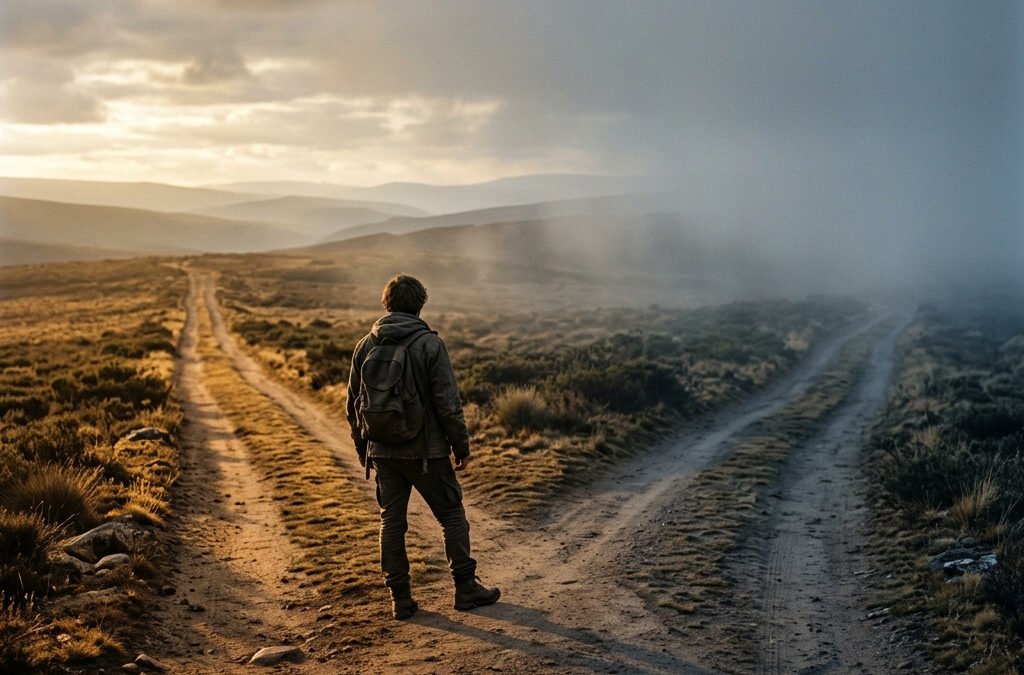
When someone says they are putting the past behind them, notice the architecture of that sentence. Behind is a location. The past is not a duration from which one escaped — it is a place the speaker has repositioned in relation to the body.
Spatial imagination organizes the unseeable by borrowing from the seeable. Time has no shape of its own, so we lend it our spatial interpretation.
What the Aymara Know
The Aymara of the Andes place the past in front of them, because the past is known and therefore visible. The future sits behind them, unseen. Their grammar is not poetic. It is precise.
What the Aymara understand, and what English quietly obscures, is that spatial orientation toward time is a cultural choice — not a natural law. The English speaker who says, “I’ve put it behind me,” is not describing reality. They are inheriting a metaphor and mistaking it for geography.
The consequences of that inheritance are not small. In the English-speaking imagination, healing becomes a relocation. To move on is to walk away from a coordinate. To carry the past is to fail at geography — to be someone who has not yet achieved the correct repositioning of a difficult place.
Recovery, in this telling, is fundamentally a spatial achievement.
Space Is Not Empty
Spaciology holds that space is not neutral and not empty. Space is historical. Every room carries the memory of who stood there before, what was decided there, what was left unresolved.
The physical and relational spaces we inhabit are not blank containers waiting to be filled with present experience. These spaces arrive already shaped — by culture, power, and the accumulated weight of everything that preceded their arrival.
The past, then, is not a location one left. It is part of the structure of the location in which we stand.
The organization that cannot seem to change its culture is not suffering from a failure of will. It is inhabiting a space whose walls were built by decisions made before anyone currently working there arrived. The person who cannot “move on” is not geographically incompetent — they are standing in a space the past helped construct.
No amount of repositioning oneself within that space changes the nature of the space itself.
Looking Directly at What Is
To put the past behind you requires changing the space itself — not your position within it, which is a more honest project than the metaphor suggests, and a harder one.
The Aymara have something to teach here, although perhaps not what we expect. Their grammar does not promise escape from the past. It promises visibility. The past sits in front of them because it is what can be seen, examined, known.
They do not relocate it. They look at it directly.
The past is not behind you, asking to be left — rather, it is woven into the space around and inside you…
Explore Further
Explore the philosophy of Spaciology, or follow these ideas into practice through RPL and UYM.
UYM Charities
Explore Spaciology’s ministry, Field Guide, teachings, and EcoDialogues. Talks, workshops, and facilitated conversations are offered without a required fee, supported by donations.
RPL
Narrative strategy and dialogue help people and organizations understand change, clarify purpose, and guide action through planning, fundraising, communications, and website development.