
As I sit here in my 50s — and yes, I am intentionally framing myself in this way — I find myself ruminating on a familiar question: Who am I ?
I asked this question for decades and answered it in so many different ways over the years. In no particular order, I have likely said the following: I’m a philosopher, an a-cultural person, a hermit, a writer, a dad, a nerd, a runner, an ultra-marathoner. There must be other terms, but I cannot think of any.
The point, however, is that at no time in my life have I ever referred to myself as a marketer, a professor, or a fundraising professional. These kinds of terms reduce me to an entity with value only insofar as I can be placed into the machinery of our capitalist society. I must have a function, and it needs to be clear. But does it?
Must I be clear about who I am?
Here I Am
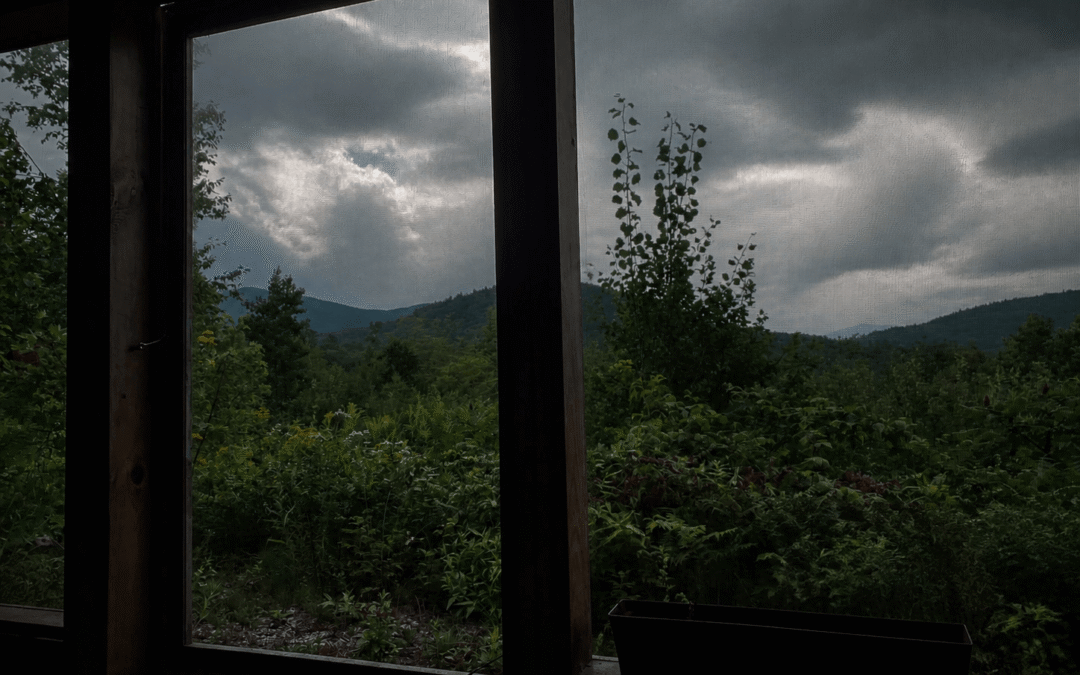
Right now, I am sitting outside in my screen room watching clouds move across the sky. It is muggy, and there are rumblings of thunder. It is glorious, and this is where I am right now. Is this who I am? Man outside watching clouds, writing words, listening to thunder?
Well, no, I must be more than this, right? I have memories, stories, heartache, dreams lost and forgotten, plans diverted, hopes, fears, love, anger, ideas, and tears. Surely, I am all of these things, and yet the reality is that who I am is a complicated question with answers that shift with the tides of my life.
Who I am seems quite dependent on where I am and, especially, how I am.
I Am Here
To say I am here is different than here I am. The former statement subtly implies I am even if I were not here, whereas the latter phrase indicates a relationship between here and myself such that I am.
Am I simply playing with words, or is there something substantive in what I am suggesting? I am not playing with words, and so I am suggesting that the question, Who am I, cannot be reasonably entertained without a consideration of right now.
In other words, who am I is not a question that can be asked and answered as if it were a linear exercise with binary answers or sentiments expressed on a Likert scale. Rather, it is an open-ended question.
Where Am I?
Perhaps who am I is better expressed as a spatial query. Where am I?
Am I ensnared in the past, my traumas, or my regrets? Am I lost in space, dissatisfied in the trajectory of a life I felt would result in clarity by the time I turned 50? Am I caught up in the notion of ‘scaling,’ a classic concept that has been artfully repackaged in a world frenzied with AI?
All we need to do is press a button, and any question can be answered.
What is this madness? Can AI truly help us answer every question? Who am I? Where am I? Can it offer any of us clarity on a planet that will eventually be swallowed by our dying sun in a galaxy whose nearest galactic neighbor, Canis Major Dwarf, is 25,000 light-years away?
Where will any of us be in 5 billion years?
Who Are You?
This may be the most important question to me, because I can never answer this question for you. If I am unsure as to who or where I am, I surely must not have a legitimate clue as to who you might be.
And yet, my inability to realistically fathom you is not a deficit. Rather, it is a doorway to different kinds of spaces — and these spaces are worth exploring together, because someday we will not be able to ask, much less answer, any question of any kind.
So who am I? Here I am, because here, I am…
Spaciology Learning Commons
Want to go further? Join the Spaciology Learning Commons.
Membership is free and gives you access to community conversations, courses, introductory resources, and the complete Spaciology Field Guide.
RPL
Your story is your strategy.
RPL helps individuals, organizations, and teams turn narrative into infrastructure—aligning purpose, leadership, fundraising, culture, and communication around one coherent story.
Whether you are a person navigating a life transition, a leader seeking clarity, or an organization preparing for what is next, we help you move from scattered to strategic.
About Spaciology
Spaciology is not abstract theory; rather, it is a practice you can feel.
- Inside: Pause, breathe, notice.
- Outside: Design rooms, rituals, and agendas that slow the spin and invite care.
- Between us: Make dialogue a place where different truths can live together long enough to teach something.
Ultimately, leadership is the art of making space for what’s important (for everyone) and letting that clarity shape the next step. When we change the spaces from which we lead, our strategies change with them.
Stay in Touch
