
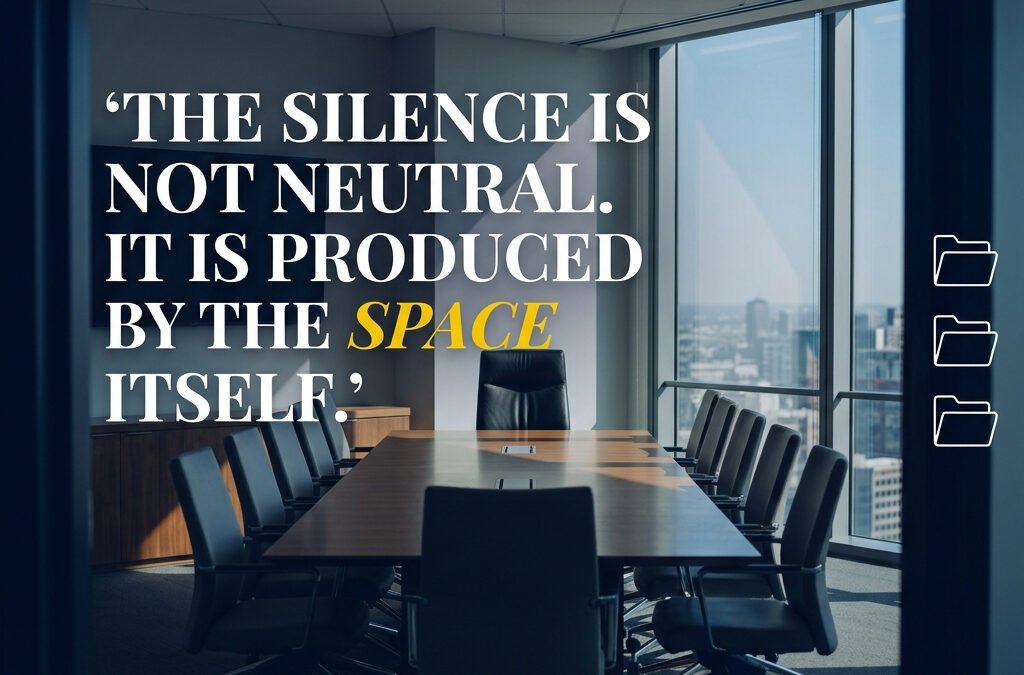
I have been thinking about the conference room at the end of the hall in a recent engagement. It had a long rectangular table, the kind that seats twelve but really seats three.
The CEO always took the head. The VP of Operations sat to his right. The rest of us arranged ourselves in descending order of perceived importance, a silent negotiation that happened before anyone said a word.
We called it a strategy meeting, but the strategy was already decided before we walked in. The people at the head of the table spoke first, spoke longest, and set the terms for everything that followed.
The rest of us responded to what they said, built on their threads, or stayed quiet. The first speaker anchored the entire conversation, and the rest of the meeting became a response to that initial comment.
This is not a story about bad people or broken processes. This is a story about space and the politics embedded in it.
Space Is Never Neutral
Every space carries history, memory, and power dynamics that shape who can speak and who stays silent. The architecture of a room, the arrangement of chairs, the proximity to decision-makers, the order of speaking—these are not incidental details. They are the infrastructure of inclusion and exclusion.
Research from Stanford University shows that individuals seated at the head of rectangular tables receive 38% more eye contact and maintain speaking turns 23% longer than those seated elsewhere.
This is not because they have better ideas. It is because spatial positioning creates what researchers call “presence magnification”—a convergence of factors that enhance perceived authority and influence.
But the politics of space extend far beyond seating arrangements. Infrastructure itself serves as a physical and symbolic contributor to economic and social inequality.
Architectural exclusion is powerful precisely because it is unseen, allowing systems to shape our actions without our perceiving that our experience has been deliberately shaped.
Lawmakers and judges often give these exclusionary impacts little to no consideration, which means the politics of space operate beneath conscious awareness.
Who Gets to Speak
I have watched meetings where the same three people dominate every conversation while ten others sit in silence. The pattern is so predictable that you can map it before the meeting starts.
Power dynamics, personality styles, different ways of processing information, and ingrained habits all contribute to who speaks and who stays silent. The decisions that emerge from these meetings reflect what the loudest people want, while insights from quiet people never surface.
This is not an accident. Individuals holding marginalized identities are more likely to have their voices “demobilized, disrespected, and dismissed”—particularly women, LGBTQIA+, BIPOC, and other marginalized communities.
People with marginalized identities hold back their voices due to fear of negative career consequences. Their ideas are easily overlooked, stolen, or wrongfully credited due to power differences.
The silence is not neutral. It is produced by the space itself—by who sits where, who speaks first, whose ideas get picked up and amplified, and whose contributions disappear without acknowledgment.
The Ethical Dimension
Making space is not a facilitation technique. It is an ethical act.
When I talk about making space, I am not talking about letting everyone have a turn to speak or running an efficient meeting. I am talking about creating conditions where different worldviews can interact through reflexive and dialogic processes—where relationships develop on multiple levels, and no single perspective dominates by default.
This requires acknowledging that the space itself is not neutral. It has been shaped by decisions—some conscious, most not—that privilege certain voices and marginalize others. Creating an ethical space means recognizing these dynamics and actively working to reconstruct them into collaborative partnerships underpinned by equality.
But here is where it gets uncomfortable. Making space for the Other—for the person whose experience, identity, or perspective has been systematically excluded—means confronting the ways we have benefited from that exclusion.
It means recognizing that our comfort, our authority, our ability to speak without interruption, has often come at the expense of someone else’s silence.
What Making Space Actually Looks Like
I have learned that making space is not about adding a diversity statement to the agenda or asking if anyone else has thoughts. It is about fundamentally rethinking how we structure the conditions for dialogue.
It means noticing who speaks first and whether that person always speaks first. It means observing who gets interrupted and who interrupts.
It means paying attention to whose ideas are correctly attributed and whose ideas are absorbed into the collective without acknowledgment. It means recognizing that silence is not always consent or agreement—it is often the result of a space that has not been made safe enough for certain voices to emerge.
Making space also means confronting the architecture itself.
If your conference room has a head of the table, you have already encoded hierarchy into the space.
If your meeting always follows the same order of speakers, you have created a pattern that privileges the same voices.
If your organization’s decision-making processes require people to advocate loudly for their ideas in competitive environments, you have designed a system that favors certain communication styles and marginalizes others.
The Absence of Voices
A review of 7,500 articles published in the Journal of Business Ethics and Business Ethics Quarterly between 2000 and 2019 found that only 78 studies addressed marginalized groups. Voices as quotations were “completely absent from the dominant discourse,” treating marginalized people’s voices as “theoretically worthless.”
This is not just an academic problem. It reflects a broader pattern in organizations where the perspectives of marginalized individuals are systematically excluded from the conversations that shape policy, strategy, and culture.
The absence is so normalized that we do not even notice it. We call it a strategy meeting, a leadership discussion, a planning session—and we never ask who is not in the room and why their absence matters.
An Invitation, Not a Conclusion
I do not have a five-step process for making space. I do not have a framework that solves this problem. What I have is an ongoing inquiry into the ways space shapes what becomes possible and who gets to participate in that possibility.
Making space is not something you do once and check off the list. It is a practice of noticing—noticing who speaks, who stays silent, whose ideas get picked up, and whose contributions disappear.
It is a practice of questioning—questioning the assumptions embedded in how we arrange rooms, structure meetings, and design decision-making processes. And it is a practice of making room—literally and relationally—for voices that have been systematically excluded.
The politics of space are not abstract. They are present in every meeting you attend, every room you enter, every conversation you facilitate.
The question is whether you are willing to see them and whether you are willing to do the uncomfortable work of making space for the Other.
Explore Further
Explore the philosophy of Spaciology, or follow these ideas into practice through RPL and UYM.
UYM Charities
Explore Spaciology’s ministry, Field Guide, teachings, and EcoDialogues. Talks, workshops, and facilitated conversations are offered without a required fee, supported by donations.
RPL
Narrative strategy and dialogue help people and organizations understand change, clarify purpose, and guide action through planning, fundraising, communications, and website development.