
I have sat across from clients who asked me what my ROI was, wanting numbers—a calculation, proof that I was worth the investment. I remember the feeling in my body when they asked, the way my chest tightened, as I realized the question reduced me to a commodity, as if everything I brought to the work could be captured in a formula.
My ROI, aside from output, was my care and compassion, the humanity I brought to every task, the way I listened when they were struggling, the space I held as they navigated organizational conflict, and the presence I offered when certainty was lacking. I have never forgotten that question or the reductionist paradigm from which it emerged.
When we reduce professional contributions to simple calculations, we risk overlooking essential dimensions of human contribution. The cost is not abstract. It shows up in how people feel at work, in what they are willing to bring, and in what they quietly stop offering when they sense that only their output is being measured.
The Human Cost of Metrics
Research indicates that employees are increasingly defined by their data rather than their humanity. While people analytics aims to increase productivity, increased monitoring can also increase stress, reduce trust, and even cause employees to act less ethically.
Nearly two-thirds of workers anticipate that AI and metrics-driven culture will diminish workplace humanity. Recent research reveals that 63% of workers say AI and data-driven approaches will make the workplace feel less human, with 42% citing dehumanization of work as one of the most significant workforce issues.
These AI conversations concern more than efficiency. They concern atmosphere—the question of whether work remains fundamentally human.
What Gets Lost
When organizations treat people as productivity metrics, employees report feeling like mere tools, which creates troubling psychological consequences that no spreadsheet can reveal.
Being truly heard creates an experience of belonging. Authenticity creates connection. Deep listening matters more than transactional communication. These are the dimensions that make work human, and they do not appear in any dashboard.
Forward-thinking organizations are shifting from ROI to VOI, Value on Investment, recognizing that the most meaningful outcomes of wellbeing extend beyond simple financial metrics. When well-being is approached purely as a cost, its potential remains limited. The conversation must shift from “Can we afford it?” to “Can we afford not to?”
A Different Question
I still think about that client who asked for my ROI, and I wonder what they were truly seeking—certainty, control, or a way to make sense of something that resists easy categorization. Some things cannot be codified or known through numbers alone, because value exists in the space between people, the quality of presence, and the willingness to show up as we are rather than as productivity machines.
The question is whether we are willing to honor what cannot be measured while still doing work that matters. Whether we can hold space for both outcomes and humanity. Whether we can resist the pressure to reduce everything to a number on a page.
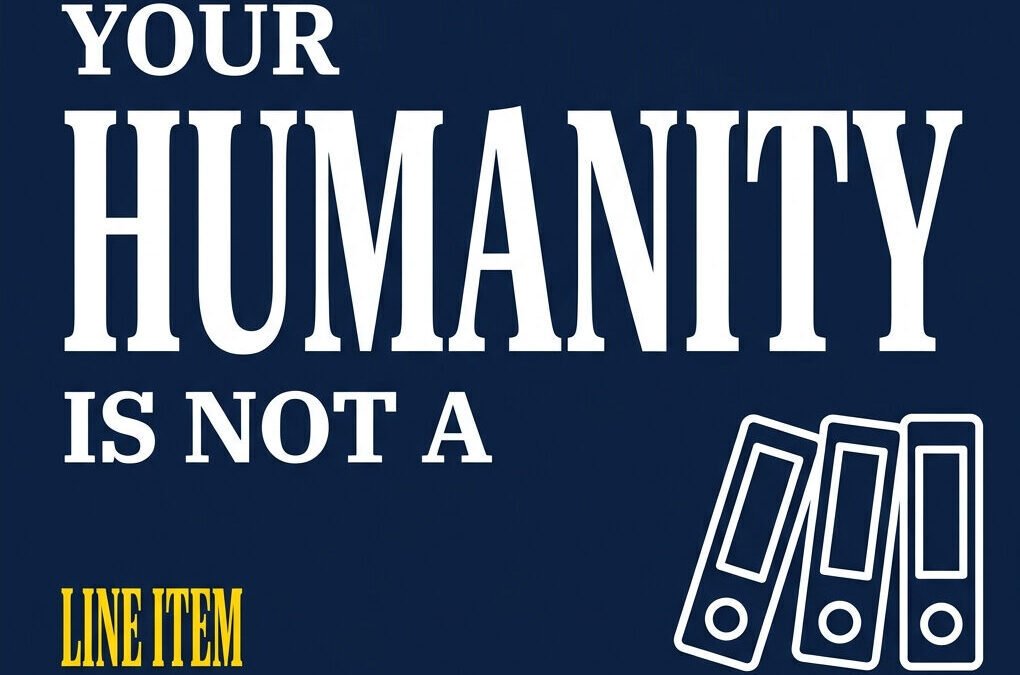
Our humanity is not a line item. It is the foundation for everything else.
Spaciology Learning Commons
Want to go further? Join the Spaciology Learning Commons.
Membership is free and gives you access to community conversations, courses, introductory resources, and the complete Spaciology Field Guide.
RPL
Your story is your strategy.
RPL helps individuals, organizations, and teams turn narrative into infrastructure—aligning purpose, leadership, fundraising, culture, and communication around one coherent story.
Whether you are a person navigating a life transition, a leader seeking clarity, or an organization preparing for what is next, we help you move from scattered to strategic.
About Spaciology
Spaciology is not abstract theory; rather, it is a practice you can feel.
- Inside: Pause, breathe, notice.
- Outside: Design rooms, rituals, and agendas that slow the spin and invite care.
- Between us: Make dialogue a place where different truths can live together long enough to teach something.
Ultimately, leadership is the art of making space for what’s important (for everyone) and letting that clarity shape the next step. When we change the spaces from which we lead, our strategies change with them.
Stay in Touch
