
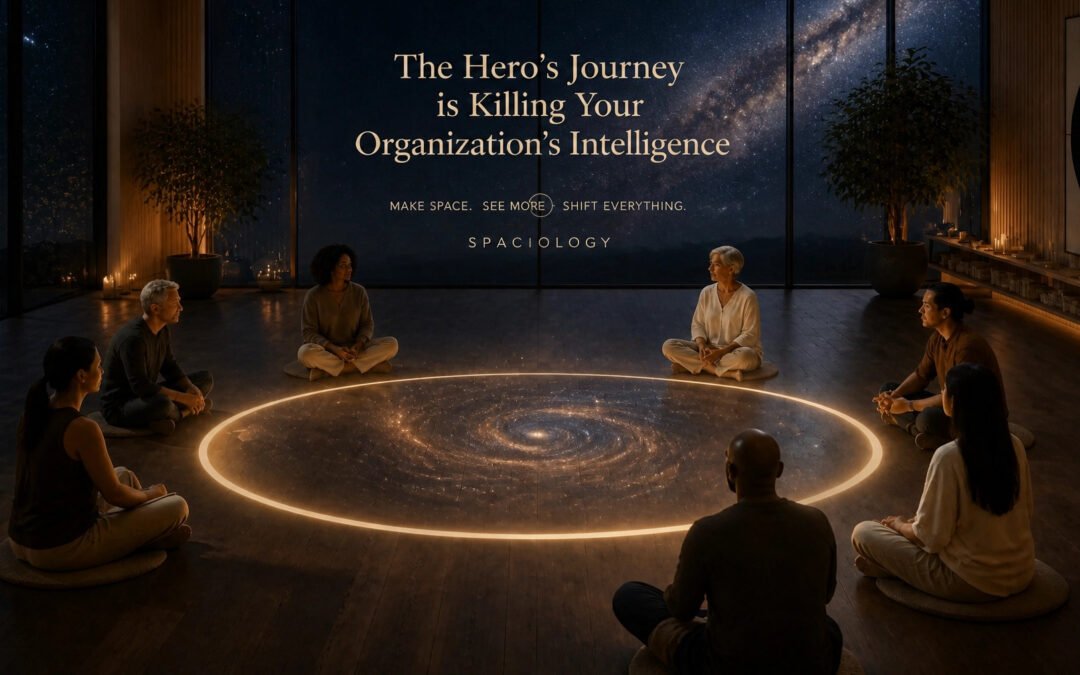
I have watched organizations celebrate their heroes while their collective capacity atrophies. We tell stories about the leader who saved the quarter, the executive who turned the ship around, the visionary who saw what no one else could see. These narratives feel good. They give us someone to point to, someone to blame or praise, someone to follow.
But here is what I have come to understand: the hero’s journey narrative is actively undermining the thing most organizations need most—the ability for more people to see clearly, decide wisely, and act together.
The data reveals something uncomfortable. While 97% of C-suite members believe they model agile behaviors, just 2% of delivery team members agree. This is not a small gap. This is organizational delusion at scale, and it emerges directly from our addiction to heroic leadership models.
Why We Keep Reaching for Heroes
The appeal is obvious. When things feel uncertain or complex, we want someone who knows the way. Someone who has been there before. Someone who can cut through the noise and tell us what to do.
This instinct runs deep. We have been telling hero stories for thousands of years—the lone figure who ventures into the unknown, faces the dragon, and returns with wisdom or treasure. The structure is so embedded in how we make sense of the world that we apply it everywhere, including places where it does not fit.
Organizations are not hero’s journeys. They are living systems where intelligence emerges from interaction, from diversity of perspective, from the quality of conversation happening at every level. When we compress that complexity into a story about one person’s vision or courage, we lose something essential.
The Fragility Cycle
Here is what happens when organizations rely on heroic leadership: the hero steps in to solve a problem. The team learns that when things get hard, someone will arrive with the answer. Over time, the organization becomes less capable of solving its own problems.
This creates a self-reinforcing fragility cycle. The very thing that makes leaders feel valuable—their ability to swoop in and fix things—is what destroys the organization’s ability to function without them. The system becomes less resilient, less scalable, more dependent.
I have seen this play out in teams where every decision flows through one person. The person becomes a bottleneck. Information stops moving horizontally. People stop trusting their own judgment. The organization’s collective intelligence shrinks to match the capacity of a single brain.
This is not a problem you solve by finding a better hero. This is a design problem.
What Collective Intelligence Actually Requires
Research on collective intelligence points to three conditions: diversity, independence, and decentralization. These are precisely the conditions that heroic leadership destroys.
When all authority and direction flow from a single source, you lose independence—people start asking “what would the leader do?” instead of thinking for themselves. You lose diversity—perspectives tend to homogenize around the leader’s view. You lose decentralization—decisions that should happen close to the work get escalated upward.
The irony is sharp. In complex environments, no single leader can hold enough perspective to solve every challenge alone. The system tries to solve a collective problem through individual authority. And the limits become visible quickly—in missed signals, in slow adaptation, in the gap between what leadership thinks is happening and what is actually happening on the ground.
What Shifts When You Stop Looking for Heroes
I am not suggesting we eliminate leadership or pretend that experience and judgment do not matter. I am suggesting we reframe what leadership is for.
Instead of the leader as the one who knows, the leader becomes the one who creates conditions where more people can know. Instead of the leader as decision-maker, the leader becomes the designer of spaces where better decisions emerge from the people closest to the work.
This requires a different kind of attention. You stop asking “what should we do?” and start asking “who needs to be in the room? What information are we missing? Where is the intelligence in this system that we have not accessed yet?”
You design for disagreement instead of consensus. You protect the conditions that allow collective intelligence to function—the diversity of thought, the independence of judgment, the distribution of authority to the edges where information is freshest.
The Uncomfortable Truth About Letting Go
This is harder than it sounds. Heroic leadership feels good. It gives you a clear role. It makes your value visible. It creates stories people can tell about your impact.
Designing for collective intelligence is messier. Your contribution becomes less visible. You spend more time asking questions than providing answers. You create space for other people to be smart instead of being the smartest person in the room.
The organizations I have seen make this shift do not do it because it feels comfortable. They do it because they hit the limits of what heroic leadership can deliver. They realize that the complexity they face exceeds what any individual can manage. They start to see the cost of dependency, the fragility of centralized decision-making, the intelligence they have been leaving on the table.
What This Looks Like in Practice
You stop intervening every time something feels uncertain. You resist the urge to have the answer. You ask the team what they see, what they think, what they would do if you were not in the room.
You design decision-making processes that distribute authority. You create structures where information flows horizontally, not just up and down. You build feedback loops that surface what is actually happening, not what people think you want to hear.
You measure different things. Not just outcomes, but the quality of thinking happening across the organization. Not just what got decided, but who was involved in the decision and whether the people closest to the work had real influence.
You tell different stories. Not about the leader who saved the day, but about the team that saw something early, the conversation that shifted how people understood a problem, the distributed intelligence that emerged when you got out of the way.
The Shift That Matters
The hero’s journey is a beautiful narrative structure. It has served us well in myth and story. But organizations are not myths. They are living systems that need to sense, adapt, and respond faster than any individual can manage alone.
The shift from heroic leadership to collective intelligence is not about removing leaders. It is about redefining what leadership is for—not to be the hero, but to design the conditions where intelligence can emerge from everywhere.
This is the work. Not finding better heroes. Not becoming a better hero yourself. But building organizations where heroism is no longer necessary because the system itself has become intelligent.
Explore Spaciology at UYM Charities
Want to go further? Explore Spaciology at UYM Charities.
UYM Charities is the home of Spaciology, with opportunities to learn about the framework, explore its practices through the Spaciology Field Guide, and discover how making space feel like home can change how we live, lead, and relate.
RPL
Your story is your strategy.
RPL helps individuals, organizations, and teams turn narrative into infrastructure—aligning purpose, leadership, fundraising, culture, and communication around one coherent story.
Whether you are a person navigating a life transition, a leader seeking clarity, or an organization preparing for what is next, we help you move from scattered to strategic.
About Spaciology
Spaciology is not abstract theory; rather, it is a practice you can feel.
- Inside: Pause, breathe, notice.
- Outside: Design rooms, rituals, and agendas that slow the spin and invite care.
- Between us: Make dialogue a place where different truths can live together long enough to teach something.
Ultimately, leadership is the art of making space for what’s important (for everyone) and letting that clarity shape the next step. When we change the spaces from which we lead, our strategies change with them.