
When The Space Tells You to Leave

What the Space Was

This was a space organized around certainty. The client felt they knew what was wrong and what needed fixing. They wanted implementation, not inquiry. They valued ROI over method, outcomes over process, answers over questions.

I kept offering complexity: evidence that their single-cause explanations missed systemic dynamics, research showing that the problems they saw “out there” were partly constructed by how they were looking. This was not what the space was designed to accommodate.

What I Kept Doing

When they dismissed the frameworks, I brought more evidence. When they minimized the research, I worked harder to demonstrate value. I treated their rejection as a problem to solve rather than information about what kind of space this was.

I was not reading the space—I was trying to change it. The space had already organized itself around particular power dynamics, particular ways of knowing, particular definitions of value. I kept acting as if those were negotiable.

What I Did Not Notice

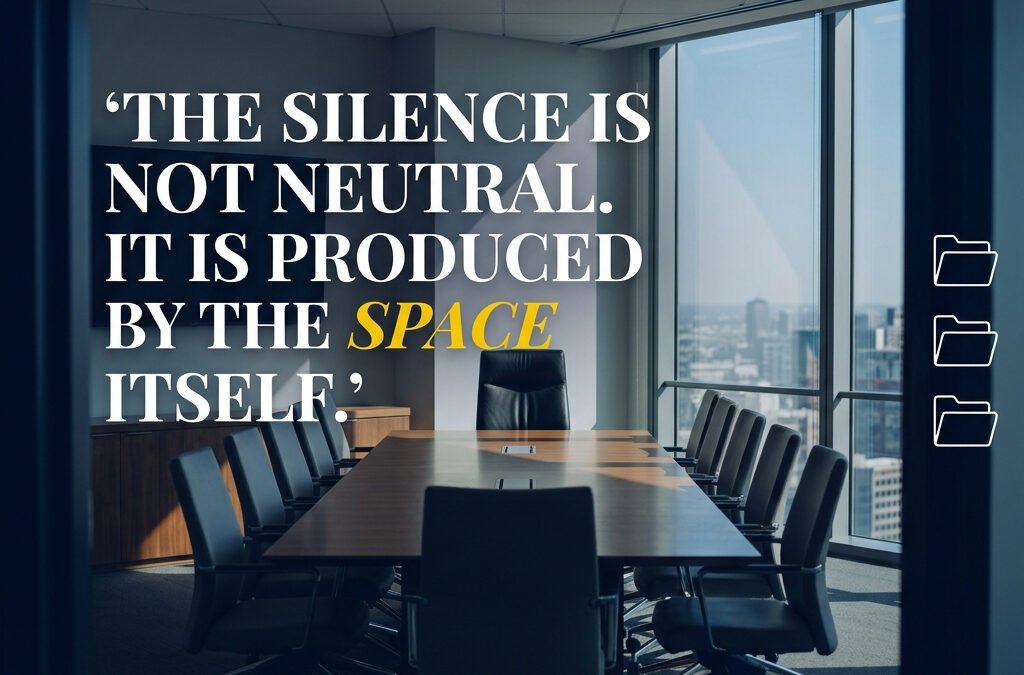
The space was not neutral. It had a history, a structure, a logic. It rewarded certain contributions and rendered others invisible. What I offered became increasingly amorphous—not because it lacked rigor, but because the space had no category for it.

This happens when diverse ways of knowing meet environments that have no room for them. The knowledge does not disappear—it just becomes unrecognizable within that space’s existing framework.

The Spatial Reading I Missed

Spaciology invites a shift in how we understand knowledge—not as something we possess, but as something that emerges from the spaces we inhabit. Some spaces are organized to welcome multiple perspectives, uneven communication, and social perceptiveness—the conditions research shows produce collective intelligence. Other spaces are organized around singular vision, hierarchical decision-making, and predetermined outcomes.

Neither is inherently wrong. They are just different kinds of spaces that accommodate different kinds of work.

I was in the second kind of space, offering the first kind of approach. That is not a moral failure on anyone’s part—it is a mismatch, but I kept treating it as something I could fix if I just worked harder, stayed longer, brought better evidence.

What Walking Away Means

Some spaces cannot accommodate certain kinds of work. Some clients have already decided what they need and are not interested in examining whether that need is part of the problem. Some organizational structures are embedded with constraints that no amount of effort can change.

The spatial reading is simple: read the space for what it is, not what you wish it could become. When the space tells you it is not designed for what you offer, that is not a challenge to overcome—it is information upon which to act.

I stayed too long. This realization seems simple, but it is anything but simple. It is hard to see when you are in it. I did not see it until I had already exhausted myself. Not every space is mine—or yours—to change. Sometimes the most accountable thing you can do is leave.

Spaciology Learning Commons

Want to go further? Join the Spaciology Learning Commons.

Membership gives you free access to community conversations, courses, introductory resources, and the complete Field Guide.

About Spaciology

Spaciology is not abstract theory; rather, it is a practice you can feel.

  • Inside: Pause, breathe, notice.
  • Outside: Design rooms, rituals, and agendas that slow the spin and invite care.
  • Between us: Make dialogue a place where different truths can live together long enough to teach something.

Ultimately, leadership is the art of making space for what’s important (for everyone) and letting that clarity shape the next step. When we change the spaces from which we lead, our strategies change with them.

Stay in Touch

The $48 Billion Industry That Changed Nothing

The $48 Billion Industry That Changed Nothing

The personal development market hit $48.4 billion in 2024. People bought books, downloaded apps, enrolled in webinars, and subscribed to podcasts. They consumed content about productivity, relationships, mindfulness, and transformation.

And then they went back to living exactly as they did before.

I am not saying this to be dismissive. I am saying it because the research shows that despite 72% of people buying self-development books and over 50% of app users accessing motivational content daily, only 25% of webinar participants actually apply what they learn within a week.

You Are Consuming Personal Development Like Entertainment

The problem is not the quality of the content. The problem is that people treat personal development like Netflix. They consume it, feel inspired for a moment, and move on to the next episode.

This is not how transformation works.

Neuroplasticity research reveals that behavioral change requires physical alterations in the brain. You need intention, attention, and persistence to forge new neural pathways. Passive content consumption does not provide the experiential engagement necessary to create these structural brain changes.

You cannot listen your way into a different life. You cannot read your way into a new relationship with yourself. You cannot podcast your way into internal transformation.

The Gap Between Knowing and Building

Psychology defines learning as a relatively permanent change in behavior or knowledge that results from experience—not just exposure to information. Even if you acquire the right knowledge in a course, it is not the same as doing the behavior.

Most personal development experiences focus on building knowledge and inspiring motivation. They ignore the third element that behavior change research identifies as essential: a reliable prompt to trigger the behavior in the moment you need it.

  • This is why you can know exactly what you should do and still not do it.
  • This is why you can feel deeply motivated and still find yourself stuck in the same patterns.
  • This is why a single course, no matter how well designed, will fail to create lasting change.

What Construction Actually Requires

When I built the Spaciology Learning Commons, I built it as a space for construction, not consumption. The difference matters more than you might think.

  • Consumption is extraction. You take what you need and move on. You look for answers that address something specific within yourself. You treat content as a resource to mine.
  • Construction is co-creation. You bring your lived experience into a shared space. You ask questions of yourself and others. You build internal architecture through ongoing practice in authentic contexts.

The Commons is not a course with modules and lessons. It is not a program that delivers answers. It is a shared space where people work on reimagining their relationships with themselves and others.

I contribute my ongoing work with Space as Metaphor. Members contribute their lived experiences. We teach and learn from one another.

We hold complexity together. We explore uncertainty as a generative force rather than a problem to solve.

Who This Actually Serves

The Commons will work well for people who are curious about making changes in their lives. These are people already looking for something, already feeling unsatisfied with how things feel right now.

It will not work well for people who hold what they think and feel as absolute truth. The work can feel messy and nonlinear. It requires a willingness to sit with uncertainty. It asks you to question rather than defend.

If you resist the implications that may result from working with space as a metaphor, the Commons will feel uncomfortable. If you need definitive answers and linear progress markers, you will struggle here.

However, if you are willing to reimagine how you relate to the world and yourself, the Commons offers something most personal development experiences do not: a place to actually build the internal architecture that determines how you experience everything.

The Shift From Time to Space

People tell me they do not have time for this work. I understand that response. We struggle with time in ways that feel very real. But I am not asking you to find time. I am asking you to find space.

Space is both metaphorical and practical. It exists within you, around you, between you and others. It intersects with care, compassion, love, understanding, and the ability to hold complexity.

When you find the space, you make time. When you locate the internal room to explore, the external schedule adjusts. This is not magical thinking. This is what happens when you shift from consuming content to constructing yourself.

What Happens Next

The Spaciology Field Guide provides concrete examples of how space-as-metaphor concepts actually play out. It prepares you for the work we do together in the Commons. It helps you conceptualize what all of this really means in practical terms.

The Commons itself is where you bring yourself fully into shared space. Where you work on the internal architecture that shapes your experience. Where you co-create with others who are also bringing their lived experiences into the room.

This is not about consuming more content. This is about constructing something that lasts.

You can keep consuming personal development like entertainment. You can keep collecting insights without building anything with them. That is a valid choice, and there is no judgment in it.

Or you might find yourself curious about what construction actually feels like. A place where questions matter more than answers. Where uncertainty is generative. Where you build alongside others doing the work.

The Commons exists for people exploring that shift. If that resonates with where you are right now, I welcome you there.

Spaciology Learning Commons

Want to go further? Join the Spaciology Learning Commons.

Membership gives you free access to community conversations, courses, introductory resources, and the complete Field Guide.

About Spaciology

Spaciology is not abstract theory; rather, it is a practice you can feel.

  • Inside: Pause, breathe, notice.
  • Outside: Design rooms, rituals, and agendas that slow the spin and invite care.
  • Between us: Make dialogue a place where different truths can live together long enough to teach something.

Ultimately, leadership is the art of making space for what’s important (for everyone) and letting that clarity shape the next step. When we change the spaces from which we lead, our strategies change with them.
Stay in Touch

When the Performance Stops, the Learning Starts

When the Performance Stops, the Learning Starts

Just a few classes into teaching business through a postsecondary prison education program, I have already learned more from my students than I could possibly teach them.

There is no room for performance in this space. The students do not have the luxury of pretending, and neither do I—and when you strip away the polished presentations, the curated expertise, the need to appear as if you have it all together, what emerges is electric. This is what I call non-performance, and it is transforming my understanding of the conditions under which genuine learning becomes possible.

What I Am Learning

In traditional classrooms, there is an unspoken contract: the teacher performs expertise, the students perform engagement, and everyone maintains the illusion that learning is a one-way transfer of knowledge. In this classroom, that contract does not hold.

In this program in particular, my students have lived experiences that far exceed anything I could teach from a textbook. They have navigated systems, survived impossible circumstances, and developed wisdom that comes from being fully present to reality—not performing their way through it. If I were to walk into that space pretending I have all the answers, they would see right through it, and more importantly, it would close off the very thing that makes learning possible.

Instead, I choose to drop the mask—to say “I do not know” when I do not know, to share the messy, half-formed ideas alongside the polished ones, to ask questions I do not have answers to and genuinely listen to what emerges in response. Something remarkable happens when I do this: the entire space shifts. When one person drops the performance, it creates permission for others to be real, too, and authenticity becomes contagious. The distance that usually exists between teacher and student—that careful separation maintained by expertise and authority—collapses, and what replaces it is connection, possibility, and the kind of learning that actually transforms people.

The Cost of Performance

I am starting to see how much energy we spend maintaining the illusion of having it together. In most professional spaces, we are rewarded for polish, confidence, and the appearance of knowing exactly what we are doing—but that performance creates a barrier to actual learning and genuine connection.

Research on performance-based work cultures shows that when people focus on meeting performance standards, they grow alienated from colleagues and frustrated by a lack of time to pursue work aligned with their actual interests—the very systems designed to measure success create barriers to authentic engagement. In the prison classroom, I watch this play out in reverse. Without the pressure to perform, my students show up with a rawness and honesty that is rare in traditional educational settings, bringing their full selves—their struggles, their questions, their lived expertise—into the space, and when I match that honesty with my own, the learning becomes reciprocal.

In this space, I am reminded that transformation does not happen in the polished lecture—it happens in the messy, honest exchange of what is true. When I show up as I actually am—uncertain, curious, still figuring it out—it creates space for everyone else to be real. This is not about being unfiltered or abandoning boundaries, but about recognizing that the performance itself is what prevents the real work from happening.

What This Requires

Non-performance requires something specific: safety. Not just physical safety, though that matters, but the kind of safety where vulnerability is possible, where dropping the mask does not make you a target, where lived experience is valued rather than extracted.

For my students, performance has often been a survival strategy. In the criminal justice system, institutional settings, and in a world that judges them before they speak, performance protects, which is why I am not asking them to be vulnerable on demand but rather trying to create conditions where they can choose to be real, where that choice is safe and their knowledge and experience are valued.

This work is delicate. For marginalized individuals, dropping ‘performance’ can be dangerous, requiring a level of safety that may not exist in most spaces. The goal is not to demand authenticity but to create space where people can show up more fully as themselves when they choose.

Research shows that, to truly learn, teachers need to feel comfortable saying “I do not know,” and the same is true for students. When leaders admit they do not know something, they foster trust and demonstrate that they value honesty over empty assurances, encouraging a culture of learning and collaboration rather than perfectionism.

In practice, this means starting our sessions differently, giving people time to actually arrive, not just appear, beginning with what is true now rather than jumping straight into content, sharing my unfinished thinking and genuinely asking what they know about topics from their own lives, and then listening.

Why This Matters Beyond the Classroom

I keep thinking about how rare this is today. In most professional spaces, posturing dominates interactions, fear of silence drives constant talking, and the most important things get said in the parking lot after the meeting rather than in the meeting itself. Over-polished presentations hide real issues, and authenticity feels risky or unwelcome.

We wait until we are “ready” and never start, curate our expertise and lose touch with genuine curiosity, perform confidence and sacrifice the learning that happens when we admit we do not have it figured out.

What I Am Still Figuring Out

This prison education program exists because someone understood that space contains both trauma and healing. My students are working toward a college degree, but the real work is what I am just beginning to understand: creating conditions where people who have been told they are disposable can discover their own agency, worth, and capacity to contribute.

Non-performance is not a technique I can package into a five-step process. Rather, it is a way of being in relationship with others that prioritizes what is real over what is polished, what is true over what is impressive.

I call this entry in my Spaciology Field Guide “Non-Performance Is the Point” because I am learning that the spaces we create are physical, relational, and emotional, and shape what becomes possible. When we drop performance, we create what I think of as home-like space, where being is privileged over appearing, shared space where one person’s authenticity gives permission for others to be real, and we collapse the distance that performance creates, opening up connection and possibility.

This idea connects to other things I am exploring, which is how listening becomes love, how care can be structured into our systems, and how boundaries actually create compassion rather than distance, which is all part of understanding that transformation requires both disruption and safety.

When we drop performance, we disrupt the status quo, but we can only do that when the space itself is safe enough to hold what is real. I am just a few classes into this teaching experience, and I already see how much I have to unlearn, how much I have to let go of my own performance to create space for genuine learning.

Non-performance is the only way this works.

About Spaciology

Spaciology is not abstract theory; rather, it is a practice you can feel.

  • Inside: Pause, breathe, notice.
  • Outside: Design rooms, rituals, and agendas that slow the spin and invite care.
  • Between us: Make dialogue a place where different truths can live together long enough to teach something.

Ultimately, leadership is the art of making space for what’s important (for everyone) and letting that clarity shape the next step. When we change the spaces from which we lead, our strategies change with them.

Spaciology Learning Commons

Want to go further? Join the Spaciology Learning Commons.

Membership gives you free access to community conversations, courses, introductory resources, and the complete Field Guide.

Stay in Touch

Stay in Touch

The Space Between What Worked and What Works Now

#image_title

I have watched nonprofit founders navigate a particular kind of confusion that surfaces when their organizations begin to grow, and what strikes me most is how rarely anyone names what is actually happening. The skills that launched the organization—the ability to move quickly, to wear every hat, to make decisions in hallways and over coffee—become the very things that prevent the organization from reaching its next stage of development. This is not a failure of leadership, but it is a transition that demands recognition.

The Dangerous Comfort of Fuzzy Structures

In the early days of a nonprofit, a fuzzy organizational structure feels like freedom. Decisions happen organically, roles shift based on who shows up, and the mission moves forward through collective will and shared passion. This fluidity works because everyone involved understands the informal agreements, the unspoken hierarchies, and the ways things get done without needing to be written down or formalized.

When you introduce paid staff into this environment, however, the lack of clarity becomes crippling. Staff members need to understand to whom they report, their responsibilities, and how their performance will be evaluated. They need job descriptions, clear communication channels, and accountability structures that simply do not exist in volunteer-driven models. What felt like collaborative flexibility to volunteers feels like organizational chaos to employees who are trying to do their jobs well.

The board faces its own reckoning during this transition. As one analysis of this shift notes, organizations often find themselves caught in a space between structures for years, embroiled in painful issues while naming symptoms but rarely facing the true cause—failing to fully transition from one organizational model to another. The board has to relinquish operational authority and allow staff to hold far more authority than they have in the past.

When Founder Skills Become Organizational Constraints

I think about the founder who launched a food bank from her garage, who knew every volunteer by name, who could pack boxes, write grants, and manage the social media account all in the same afternoon. Her ability to do everything was the reason the organization survived its first three years. When the organization hired its first program director, however, that same founder struggled to delegate, to trust someone else’s judgment, to step back from daily operations and focus on governance and strategic direction.

This pattern repeats across the nonprofit sector with remarkable consistency. The entrepreneurial instincts that create organizations—the willingness to act without perfect information, the comfort with ambiguity, the ability to pivot quickly—do not necessarily translate into the management skills required to lead a growing entity with multiple staff members, complex programs, and increasing demands for accountability.

The data reveals the scope of this challenge. Only 30 percent of C-suite roles in the nonprofit sector were filled by internal promotion in the past two years, about half the rate of for-profits. This suggests that organizations are not developing leadership pipelines, not preparing their teams for the transitions that growth inevitably requires.

What the Transition Actually Demands

The shift from volunteer-based to staff-driven operations requires more than hiring people and writing job descriptions. It demands a fundamental reimagining of how the organization functions, how decisions get made, and where power resides. The board must move from doing the work to governing the work, from managing programs to setting policy and ensuring accountability.

This transition asks founders to examine whether their current skills serve the organization’s current needs. It asks board members to release their attachment to operational control and embrace their role as strategic overseers. It asks everyone involved to acknowledge that the informal structures that worked beautifully at one stage of development may need to be replaced with more formal systems as the organization matures.

I have noticed that the organizations that navigate this transition successfully tend to approach it with curiosity rather than resistance. They ask questions about what structures would serve their staff well, what governance practices would support rather than hinder their mission, and what leadership development their team needs to grow into new roles. They recognize that this transition is not about abandoning the passion and commitment that launched the organization, but about channeling that energy through structures that can sustain and amplify it.

The Path Forward Exists in Present Choices

You do not need to have all the answers before you begin this transition. What you need is a willingness to acknowledge that the transition is happening, that it requires attention and intention, and that the skills that brought you here may not be the skills that take you forward. The organizations that struggle most are not those that lack resources or talent, but those that refuse to name what is actually occurring and make space for the structural changes that growth demands.

The choice available to you now is whether to attend to this transition with care and deliberation, or to allow it to unfold in ways that create confusion, conflict, and missed opportunities. The fuzzy organizational structure that once felt like freedom can become the barrier that prevents your mission from reaching the people who need it most. What worked when you were five volunteers meeting in someone’s living room may not work when you are fifteen staff members serving hundreds of clients each month.

This recognition does not diminish what you have built. It honors it by asking what it needs to become next.

About Spaciology

Spaciology is not abstract theory; rather, it is a practice you can feel.

  • Inside: Pause, breathe, notice.
  • Outside: Design rooms, rituals, and agendas that slow the spin and invite care.
  • Between us: Make dialogue a place where different truths can live together long enough to teach something.

Ultimately, leadership is the art of making space for what’s important (for everyone) and letting that clarity shape the next step. When we change the spaces from which we lead, our strategies change with them.

Spaciology Learning Commons

Want to go further? Join the Spaciology Learning Commons.

Membership gives you free access to community conversations, courses, introductory resources, and the complete Field Guide.

Stay in Touch

Stay in Touch

Your Environment Is Your Architecture

Many of us are struggling to understand our worth outside the economic engine of society. The message is rarely stated outright, but it saturates the air: to be more, we must not only do more, but also buy more. This assumption fuels countless conversations—at work, at home, and inside our own heads.

I am guilty of this, too. AI has accelerated the tempo of professional life, and I catch myself turning that tempo into a test of relevance. I ask colleagues whether they now use it to generate content, manage social media campaigns, or prospect for donors. I have been shown tools that “strategize,” producing plans and roadmaps for organizations in minutes. I keep wondering where these plans and roadmaps ultimately lead—or, more pointedly, what they train us to believe about the kind of human being we have to become in order to matter.

This past weekend, I picked up Philosophical Leisure (2007) by Dr. Annette Holba, and she reminded me—uncomfortably—that we have already arrived at a destination. Lasch (1979) described this place as a culture of narcissism. Arnett (1994) framed it as a kind of existential homelessness. In such a place, Holba argues, “human communication is enveloped with a general sense of malaise that is the result of an emerging lack of the interhuman or authentic interest in the other” (p. 21).

One corollary of that condition is that our worth gets measured—quietly, relentlessly—in productivity. Reflecting on this (and spurred by Holba’s work), I can see that I still subscribe, at least partially, to a familiar Western equation: productivity equals value.

While I no longer check work emails on the weekend, I still feel a concern in my body that I am somehow derelict in my professional duties. How dare I enjoy myself? How dare I be a philosopher, when clearly there are more important things to do—master the latest tools, find the next corporate sponsor, issue the next press release, create the next post, stay visible, stay useful.

It isn’t only that I’m anxious about productivity. I have also sabotaged my personal life in an effort to demonstrate commitment to organizational causes. In recognizing that my positionality as a CIS white man has afforded me an unbelievable amount of privilege and opportunity, I find myself struggling to feel I can offer anything of value outside my output—as if I must keep producing to justify my place in any space.

I do not say any of this to elicit pity. I’m saying it because I’m coming to grips with a stark fact. I have built a life in which “work” is the main space where I feel legible.

I do not really make friends, but my ability to merge the personal with the professional has enabled me to create the illusion of a life full of meaning. As a philosopher and poet in my heart, the extent to which I have sacrificed hopes and dreams in an effort to apologize for my existence is exhausting.

Identity Matters

Race, gender, class, and history shape what happens to us and our experience of reality. However, when identity becomes the only story available—when it replaces curiosity, tenderness, and complexity—we reduce one another. We turn living people into categories and then act surprised when our relationships feel thin.

Certainly, the fact that I am a CIS white man is an important fact of my existence, and it has influenced my experience as a human being. However, I am also a man who sometimes cries when he hears beautiful music, or while making egg sandwiches.

I am a man who enjoys walking in nature, running down country roads on Friday afternoons, watching The Rockford Files at midnight, and missing the days when my sons were little—when they could both be held in my arms at the same time. I am also a man who loves his parents and cannot imagine a life, much less a single day, without them. I make ridiculous jokes, laugh when someone farts, and I miss my grandmother.

I am all these things and so much more (and sometimes less), which means I can only assume every human on this planet possesses forms of worth and texture that are uniquely theirs. Perhaps there is an opportunity—an opening, a space—for us to acknowledge the multiplicities of our lives without trying to reduce, eliminate, or monetize their meaning.

Not everything meaningful is measurable, monetized, or shareable, because life is not a spectacle. It is an inward journey we live together in public spaces on a planet that is literally moving through outer space right now.

In a world that keeps trying to sell us the next “optimized” solution, maybe the starting point is simpler. What do you and I actually need?

If we do not yet know how to answer that question, I think that is just fine. Let’s start in a space where we know nothing, because those spaces often offer the greatest opportunities.


References

  • Arnett, R. C. (1994). Existential homelessness: A contemporary case for dialogue. In R. Anderson, K. N. Cissna, & R. C. Arnett (Eds.), The reach of dialogue: Confirmation, voice, and community (pp. 229–245). Cresskill, NJ: Hampton Press.
  • Holba, A. M. (2007). Philosophical leisure: Recuperation and the care of the self. Lanham, MD: Lexington Books.
  • Lasch, C. (1979). The culture of narcissism: American life in an age of diminishing expectations. New York, NY: W. W. Norton.


About Spaciology

Spaciology is not abstract theory; rather, it is a practice you can feel.

  • Inside: Pause, breathe, notice.
  • Outside: Design rooms, rituals, and agendas that slow the spin and invite care.
  • Between us: Make dialogue a place where different truths can live together long enough to teach something.

Ultimately, leadership is the art of making space for what’s important (for everyone) and letting that clarity shape the next step. When we change the spaces from which we lead, our strategies change with them.

Spaciology Learning Commons

Want to go further? Join the Spaciology Learning Commons.

Membership gives you free access to community conversations, courses, introductory resources, and the complete Field Guide.


Stay in Touch